Sunday, January 24, 2010

Church Fathers on Abortion

Canterbury Tales has a post on what the Church Fathers have said concerning abortion. Here is a sample:

The Didache

"The second commandment of the teaching: You shall not murder. You shall not commit adultery. You shall not seduce boys. You shall not commit fornication. You shall not steal. You shall not practice magic. You shall not use potions. You shall not procure [an] abortion, nor destroy a newborn child" (Didache 2:1–2 [A.D. 70]).

The Letter of Barnabas

"The way of light, then, is as follows. If anyone desires to travel to the appointed place, he must be zealous in his works. The knowledge, therefore, which is given to us for the purpose of walking in this way, is the following. . . . Thou shalt not slay the child by procuring abortion; nor, again, shalt thou destroy it after it is born" (Letter of Barnabas 19 [A.D. 75-120]).

The Apocalypse of Peter

"And near that place I saw another strait place . . . and there sat women. . . . And over against them many children who were born to them out of due time sat crying. And there came forth from them rays of fire and smote the women in the eyes. And these were the accursed who conceived and caused abortion" (The Apocalypse of Peter 25 [A.D. 137]).

Athenagoras

"What man of sound mind, therefore, will affirm, while such is our character, that we are murderers?
. . . [W]hen we say that those women who use drugs to bring on abortion commit murder, and will have to give an account to God for the abortion, on what principle should we commit murder? For it does not belong to the same person to regard the very fetus in the womb as a created being, and therefore an object of God’s care, and when it has passed into life, to kill it; and not to expose an infant, because those who expose them are chargeable with child-murder, and on the other hand, when it has been reared to destroy it" (A Plea for the Christians 35 [A.D. 177]).


See the entire post here.

Saturday, January 23, 2010

One Nation Under God


H/T JillStanek.com

The Difference Between the Male and Female Mind


H/T DOMINE, DA MIHI HANC AQUAM!

Saturday, January 16, 2010

On the Mendicant Orders

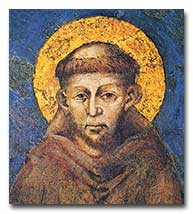
On January 13, 2010 Pope Benedict XVI during his general audience spoke on the mendicant orders of St. Francis and St. Dominic. I found it interesting and thought I would share it.

At the beginning of the new year, we look at the history of Christianity, to see how a history develops and how it can be renewed. In it we can see that it is the saints, guided by the light of God, who are the genuine reformers of the life of the Church and of society. Teachers by their word and witnesses with their example, they know how to promote a stable and profound ecclesial renewal, because they themselves are profoundly renewed, they are in contact with the true novelty: the presence of God in the world.....

On the other hand, the Franciscans and Dominicans, in the footsteps of their founders, showed that it was possible to live evangelical poverty, the truth of the Gospel, without separating from the Church; they showed that the Church continued to be the true, authentic place of the Gospel and Scripture. Thus, Dominic and Francis drew, precisely from profound communion with the Church and the papacy, the strength of their witness.

With an altogether original choice in the history of consecrated life, the members of these orders not only gave up possession of personal goods, as monks had since antiquity, but even wanted real estate and goods put in the name of the community. In this way they intended to give witness of an extremely sober life, to be in solidarity with the poor and trust only in Providence, to live every day by Providence, in trust, putting themselves in God's hands. This personal and community style of the Mendicant Orders, joined to total adherence to the teaching of the Church and her authority, was greatly appreciated by the Pontiffs of the time, such as Innocent III and Honorius III, who gave their full support to these new ecclesial experiences, recognizing in them the voice of the Spirit....

Franciscans and Dominicans were witnesses, but also teachers. In fact, another widespread need in their time was that of religious instruction. Not a few lay faithful, who lived in greatly expanding cities, wished to practice a spiritually intense Christian life. Hence they sought to deepen their knowledge of the faith and to be guided in the arduous but exciting path of holiness. Happily, the Mendicant Orders were also able to meet this need: the proclamation of the Gospel in simplicity and in its depth and greatness was one objective, perhaps the main objective of this movement. In fact, with great zeal they dedicated themselves to preaching. The faithful were very numerous, often real and veritable crowds, which gathered to hear the preachers in the churches and in places outdoors -- let us think of St. Anthony, for example. They dealt with themes close to the life of the people, especially the practice of the theological and moral virtues, with concrete examples, easily understood. Moreover, they taught ways to nourish the life of prayer and piety. For example, the Franciscans greatly spread devotion to the humanity of Christ, with the commitment of imitating the Lord. Hence it is not surprising that the faithful were numerous, women and men, who chose to be supported in their Christian journey by the Franciscan and Dominican friars, sought after and appreciated spiritual directors and confessors.


You can read the full text here.

H/T View from the Choir

Massachusetts Miracle

National Geographic - Inside the Vatican

A very interesting video from National Geographic. It is about an hour and a half long, but worth the time.


Saturday, January 9, 2010

For Those Who Hated Him

The wonder is not only that he gave his Son but that he did so in this way, by sacrificing the one he loved. It is astonishing that he gave the Beloved for those who hated him. See how highly he honors us. If even when we hated him and were enemies he gave the Beloved, what will he not do for us now?

Chrysostom - Homily on Ephesians 1.1.8
Refer to Ephesians 1:7-10

Thursday, January 7, 2010

Concerning Children with Special Needs

"The real choice in accepting or rejecting a child with special needs is never between some imaginary perfection or imperfection. The real choice is between love and unlove, between courage and cowardice, between trust and fear. And that’s the choice we face as a society in deciding which human lives we will treat as valuable, and which we will not. "

Charles J. Chaput - Archbishop of Denver

Archbishop Chaput - Homily Respect Life Mass

Roaming the internet, I ran across this homily given by Archbishop Chaput in 2003. I have not seen it before and thought I would share it. It starts:

Every lifetime has a few moments that become larger and more important as the years pass and we see them more clearly in perspective.

No husband ever forgets when he first met his wife. No mother ever forgets the birth of her first child. No priest ever forgets celebrating his first Mass. Looking back, everything in life flows from these pivotal moments, these turning points — and how we live out their consequences defines who we become.

For good or for ill, the same is true for nations. We remember July 4 because it established a new order of human dignity and freedom. And we remember Roe v Wade because it wounded and continues to undermine both.

Thirty years ago next week, the Supreme Court legalized abortion on demand. Today we’re living with the consequences. Today we can thank Roe v Wade for the killing of 40 million unborn children; tens of thousands of broken marriages; and hundreds of thousands of emotionally damaged women and men.

But those are just the obvious results. There’s much more ahead, because we’re becoming a nation that no longer remembers the words to explain why things like cloning, infanticide and physician-assisted suicide violate the sanctity of life. We’ve forgotten the language of right and wrong on exactly those issues that define what it means to be human.

Nations are living organisms. If we poison the roots of the tree, we get bad fruit. In 1973, Roe v Wade seemed to be about abortion. In 2003, we know it was really about the nature of the human person — and the callousness and inhumanity of the Roe decision have worked their way into every aspect of our public life, just like a drop of ink changes every molecule in a glass of water. We’re no longer the nation we once were. Because of this bad court decision, we are now a different nation....


See the rest here.