Sunday, June 10, 2012

God In The Streets of New York City

Take four minutes and watch this. It brought a tear to my eyes. It shows the power of the Real Presence.

H/T/ Deacon Greg Kandra
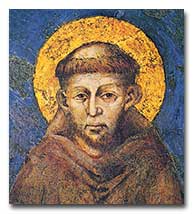
An Open Letter to My Brothers of the Franciscan First Order and to My Sisters in the Third Order Regular

I am scandalized by the presumptiveness of the leaders of the various First Order American Provinces in their recent press release of their support for the leadership of the Leadership Conference of Women Religions (LCWR) in light of the recent Doctrinal Assessment. I must ask, have you read the assessment? Had you, I cannot fathom how you could privately, let alone publicly, support these wayward ladies. Your support denigrates your own Order.

I approach you with as much humility as I can notwithstanding the extreme agitation and anxiety I am feeling over your leaders support contrary to the assessment. My own formation has taught me that when a brother or sister errors to approach them, in my love for you, so that you may amend yourselves.

In so an elementary foundation of our charism, the very teaching of Francis himself and by his example, by an expression of our humility and obedience and love, we are to be in union with the Magisterium of the Church. From where, in your vowed humility did this elitistism come? You put yourself before the Magisterium in support for the LCWR. Having the least compunction in scandalizing your brothers and sisters in the Orders, I must question your ability to properly lead them. You have fallen prey to the culture in which you live; one of hedonism and individualism.

We are called to be in conformity and give allegiance to the soul and heart of the Magisterium, as the assessment indicates.

Before I go further I extend my heartfelt appreciation for the instruction the nuns provided me, in concert with my parents, in establishing within me a love for God and my Faith. I would probably be a candidate for hell if it were not for them. I also extend my thanks to all the religious who have worked so tirelessly to bring to the world peace, charity, and social justice.

But Franciscanism, Father Francis, was not only about creation and peace and love – important as they are – but he was Christocentric and faithful to the Church and its teachings. Should we be anything less?

The assessment’s reports on the addresses given at the LCWR assemblies present a pattern of obstinacy to Church teaching. They dismiss their responsibility by saying they did not know the content of the presentations, but the pattern indicates their – if not spoken, their hidden – agenda. In addition, even if they were ill-informed as to the content of the talks, they remained unchallenged as brought to light in the assessment.

Their policies prove a corporate dissent of Church teaching: they protest the inability of the Church to ordain women; they embrace homosexuality, they continually take positions against the Church’s teachings on human sexuality. They present radical feminism and undermine our doctrines of the Holy Trinity, the divinity of Christ and the inspiration of Holy Scripture. They’re silent on right to life and natural death; they challenge positions taken by our Bishops who are our authentic teachers of faith and morals. To grant their wishes would mean to discard the essence of the Catholic Church’s Tradition. These are all serious concerns and I can only wonder and pray for the friars and religious who support the LCRW.

I understand on all our Orders there appear individuals with unorthodox ideas, opinions and agendas. But it seems these errors are pervasive. Part of the failure is in the formation process, the weeding out in the inquiry process. The infiltration of the radical liberalism in the Orders is an extremely dangerous situation. Rather than turning to Scripture and Teachings, our Rule, they are led by dissident voices who are not happy with the Church, the Order, or themselves. We are called to build the Church, not destroy it. If you are short of vocations ask yourself, why? Have you not seen the communities that are in-line with Church teaching, wear traditional values as well as their habit are thriving, while the others are dying?

My brothers and sisters need to turn back to our basic tenants of humility, obedience, and discipline. My love and prayers for them continues.

If you would like to read for yourself the Dogmatic Assessment, please go here.

Saturday, June 9, 2012

2012 Transit of Venus

Did you miss it? I did. But here is a much better look.

State Department Purges Religious Freedom Section from Its Human Rights Reports

from What Does The Prayer Really Say? (Fr. John Zuhlsdorf)

Maybe religious liberty is not a human right after all?

From CNS:

State Department Purges Religious Freedom Section from Its Human Rights Reports By Pete Winn June 7, 2012

(CNSNews.com) – The U.S. State Department removed the sections covering religious freedom from the Country Reports on Human Rights that it released on May 24, three months past the statutory deadline Congress set for the release of these reports. [Comment Fr. Z.: Hey! If they don't report on it, I guess it isn't happening, right?]

The new human rights reports–purged of the sections that discuss the status of religious freedom in each of the countries covered–are also the human rights reports that include the period that covered the Arab Spring and its aftermath.

Thus, the reports do not provide in-depth coverage of what has happened to Christians and other religious minorities in predominantly Muslim countries in the Middle East that saw the rise of revolutionary movements in 2011 in which Islamist forces played an instrumental role.

For the first time ever, the State Department simply eliminated the section of religious freedom in its reports covering 2011 and instead referred the public to the 2010 International Religious Freedom Report – a full two years behind the times – or to the annual report of the U.S. Commission on International Religious Freedom (USCIRF), which was released last September and covers events in 2010 but not 2011....

Read the whole article here. And please visit Fr. Z.'s blog here.

Pope Benedict's Corpus Christi Homily

A good homily, an important read.

"It is a mistake to oppose celebration and adoration, as if they were in competition"

ROME, JUNE 7, 2012 (Zenit.org).- This evening in Rome, Benedict XVI celebrated Mass for the feast of Corpus Christi at the Basilica of St. John Lateran. He then led the traditional procession to the Basilica of Saint Mary Major.

Here is a translation of the Pope's homily.

Dear Brothers and Sisters!

This evening I would like to meditate with you on two interconnected aspects of the Eucharistic Mystery: the worship of the Eucharist and its sacredness. It is important to take it up again to preserve it from incomplete visions of the Mystery itself, such as those which were proposed in the recent past. First of all, a reflection on the value of Eucharistic worship, in particular adoration of the Most Blessed Sacrament. It is the experience that we will also live after the Mass, before the procession, during its development and at its end. A unilateral interpretation of Vatican Council II has penalized this dimension, restricting the Eucharist in practice to the celebratory moment. In fact, it was very important to recognize the centrality of the celebration, in which the Lord convokes his people, gathers them around the twofold table of the Word and the Bread of life, nourishes them and unites them to Himself in the offering of the Sacrifice. This assessment of the liturgical assembly, in which the Lord works and realizes his mystery of communion, remains of course valid, but it must be placed in the right balance. In fact – as often happens – the stressing of one aspect ends up by sacrificing another. In this case, the accentuation placed on the celebration of the Eucharist has been to the detriment of adoration, as act of faith and prayer addressed to the Lord Jesus, really present in the Sacrament of the altar. This imbalance has also had repercussions on the spiritual life of the faithful. In fact, concentrating the whole relationship with the Eucharistic Jesus only at the moment of Holy Mass risks removing his presence from the rest of time and the existential space. And thus, perceived less is the sense of the constant presence of Jesus in our midst and with us, a concrete, close presence among our homes, as “beating Heart” of the city, of the country, of the territory with its various expressions and activities. The Sacrament of the Charity of Christ must permeate the whole of daily life.

In reality, it is a mistake to oppose celebration and adoration, as if they were in competition with one another. It is precisely the contrary: the worship of the Most Blessed Sacrament is as the spiritual “environment” in which the community can celebrate the Eucharist well and in truth. Only if it is preceded, accompanied and followed by this interior attitude of faith and adoration, can the liturgical action express its full meaning and value. The encounter with Jesus in the Holy Mass is truly and fully acted when the community is able to recognize that, in the Sacrament, He dwells in his house, waits for us, invites us to his table, then, after the assembly is dismissed, stays with us, with his discreet and silent presence, and accompanies us with his intercession, continuing to gather our spiritual sacrifices and offering them to the Father.

In this connection, I am pleased to stress the experience we will also live together this evening. At the moment of adoration, we are all on the same plane, kneeling before the Sacrament of Love. The common and ministerial priesthoods are united in Eucharistic worship. It is a very beautiful and significant experience, which we have experienced several times in Saint Peter’s Basilica, and also in the unforgettable vigils with young people – I recall, for example, those of Cologne, London, Zagreb, Madrid. It is evident to all that these moments of Eucharistic vigil prepare the celebration of the Holy Mass, prepare hearts for the encounter, so that it is more fruitful. To be all together in prolonged silence before the Lord present in his Sacrament, is one of the most genuine experiences of our being Church, which is accompanied in a complementary way with the celebration of the Eucharist, listening to the Word of God, singing, approaching together the table of the Bread of life. Communion and contemplation cannot be separated, they go together. To really communicate with another person I must know him, I must be able to be in silence close to him, to hear him and to look at him with love. True love and true friendship always live of the reciprocity of looks, of intense, eloquent silences full of respect and veneration, so that the encounter is lived profoundly, in a personal not a superficial way. And, unfortunately, if this dimension is lacking, even sacramental communion itself can become, on our part, a superficial gesture. Instead, in true communion, prepared by the colloquy of prayer and of life, we can say to the Lord words of confidence as those that resounded a short while ago in the Responsorial Psalm: “O Lord, I am thy servant; I am thy servant, the son of thy handmaid. / Thou hast loosed my bonds./ I will offer to thee the sacrifice of thanksgiving /and call on the name of the Lord” (Psalm 115:16-17).

Now I would like to pass briefly to the second aspect: the sacredness of the Eucharist. Also here we heard in the recent past of a certain misunderstanding of the authentic message of Sacred Scripture. The Christian novelty in regard to worship was influenced by a certain secularist mentality of the 60s and 70s of the past century. It is true, and it remains always valid, that the center of worship is now no longer in the rites and ancient sacrifices, but in Christ himself, in his person, in his life, in his paschal mystery. And yet, from this fundamental novelty it must not be concluded that the sacred no longer exists, but that it has found its fulfillment in Jesus Christ, incarnate divine Love. The Letter to the Hebrews, which we heard this evening in the Second Reading, speaks to us precisely of the novelty of the priesthood of Christ, “high priest of the good things that have come” (Hebrews 9:11), but it does not say that the priesthood is finished. Christ “is the mediator of a new covenant” (Hebrews 9:15), established in his blood, which purifies our “conscience from dead works” (Hebrews 9:14). He did not abolish the sacred, but brought it to fulfillment, inaugurating a new worship, which is, yes, fully spiritual but which however, so long as we are journeying in time, makes use again of signs and rites, of which there will be no need only at the end, in the heavenly Jerusalem, where there will no longer be a temple (cf. Revelation 21:22). Thanks to Christ, the sacred is more true, more intense and, as happens with the Commandments, also more exacting! Ritual observance is not enough, but what is required is the purification of the heart and the involvement of life.

I am also pleased to stress that the sacred has an educational function, and its disappearance inevitably impoverishes the culture, in particular, the formation of the new generations. If, for example, in the name of a secularized faith, no longer in need of sacred signs, this citizens' processions of the Corpus Domini were abolished, the spiritual profile of Rome would be “leveled,” and our personal and community conscience would be weakened. Or let us think of a mother or a father that, in the name of a de-sacralized faith, deprived their children of all religious rituals: in reality they would end up by leaving a free field to so many surrogates present in the consumer society, to other rites and other signs, which could more easily become idols. God, our Father, has not acted thus with humanity: he has sent his Son into the world not to abolish, but to give fulfillment also to the sacred. At the height of this mission, in the Last Supper, Jesus instituted the Sacrament of his Body and his Blood, the Memorial of his Paschal Sacrifice. By so doing, he put himself in the place of the ancient sacrifices, but he did so within a rite, which he commanded the Apostles to perpetuate, as the supreme sign of the true sacred, which is Himself. With this faith, dear brothers and sisters, we celebrate today and every day the Eucharistic Mystery and we adore it as the center of our life and heart of the world. Amen.

[Translation by ZENIT]

Friday, June 8, 2012

Wayward Ladies

Perhaps I will loose some friends with this one. But I must express my dismay of the following press release:

Franciscan Leadership Declares Solidarity With Catholic Sisters

American Provinces Release Letter to the LCWR

NEW YORK — June 7, 2012 — As follow-up to the recent Vatican assessment of the Leadership Conference of Women Religious (LCWR), the leaders of seven entities of Franciscan friars have released a letter to the Catholic sisters expressing their strong support.

Several weeks ago, the Vatican Congregation for the Doctrine of the Faith (CDF) released its assessment of the Leadership Conference of Women Religious, the support system and public voice of some 1500 leaders of women’s congregations, representing over 80% of the women religious in the United States. This assessment was highly critical of the LCWR and demanded changes in its organization and activities. Like many American Catholics, Franciscan friars across the country have been deeply concerned by this document, especially its impact on their sisters in religious life, many of whom belong to Franciscan congregations.

The provincial ministers of the seven provinces of the Order of Friars Minor in the United States, representing more than 1250 religious men, released the following statement to express their appreciation of the invaluable ministry of American religious women and to extend their support to the members of the LCWR, as they attempt to respond to the concerns expressed in the Vatican directives.

My response is this:

All Franciscans are to follow the Magisterium of the Church, as Francis taught, not make Catholicism what they want it to be.

o·be·di·ence: Noun: 1. Compliance with someone's wishes or orders or acknowledgment of their authority. 2. Submission to a law or rule.

I made a promise, a profession, the Friars, and the Sisters made a vow.

I am scandalized, I am appalled, when I see Catholic nuns, in public, supporting abortion and taking other positions contrary to the basic teachings of the Church.

It is sad the Friars choose to publicly side with these wayward ladies.

I have just unsubscribed to two Franciscan Friar blogs because of this.

Stand Up for Religious Freedom

Too short not to post in its entirety. But do visit Father Dwight's blog.

Fr Longenecker speaking at the Greenville Stand Up for Religious Freedom Rally. If they violate religious freedom of Catholics they will be able to violate everyone else’s, and they cannot suppress religious freedom without also suppressing freedom of speech and freedom to gather and freedom to protest. “We had better stand together or we will all hang separately.”

Thursday, June 7, 2012

Islamic Immigration or Let's Make Babies - Quick!

A couple of months ago I was at a community expo representing my parish, handing out information, and answering questions. The booth next to us happened to represent the area's Islamic mosques. I was quite surprised, toward the end of the day when there were less people about, one of the Islamic men can over to me and tried to convert me on the spot. He was a little pushy and insistent. We discussed some points back and forth and I was surprised he knew the Holy Bible quite well, at least chapter and verse supporting what he was attempting to get across to me. I could see how some people weak in their faith might listen to their arguments. I conclude Muslims are trying very hard to convert Christians. We know what is unsaid is that if you are not a Muslim you should be dead. Shortly after this I boned up a bit on Muslims, reading some Catholic apologetics about the Muslim faith. The Koran has never been studied as our Bible has been. It has never undergone any exegesis. There has never been independent corroboration that Muhammad even existed. It is postulated that it was written by a Jew. Today, someone sent me a video on Islamic immigration into Europe and America (see below) I was mildly surprised of its content, as I have known from various sources in the past that Europeans and Americans have a very low birth rate, so low, that we are not replacing ourselves, though our population stays up due to an enormous amount of legal and illegal immigration. I did a little research and found an article disputing some of the numbers, though it was posted by an interfaith organization which indicates a desire to show the Muslims in a positive light. But the fact remains that their birth rate is a lot higher than ours or the Europeans. So it is not wrong to acknowledge the shifting demographics. The video is about three years old. I also found a report on the same topic in an interview with a writer,(below). which is two years old. Now, what happens when Muslims become the majority? Will they be as tolerant of us as we are of them now? I think not, knowing their various stances and history. Their history from they very start was to conquer and convert, or else! By coincidence, also today, I ran across the picture below. I apologize for it being graphic, but at times visualizations are necessary. I had not seen this before and I tried to validate it. Have you heard of the Armenian genocide? You only need to do a Google search for images and see the Wikipedia article. (Below: A line of naked crucified Armenian girls). I am not saying the sky is falling, but the facts are disturbing, and I fear and wonder what is going to happen. You can surmise the future yourself. We are killing our culture from abortion and contraception. We need to evangelize those of our faith who are un-churched, and yes, we need to start making babies.

Friday, June 1, 2012

June is the Month Dedicated to the Sacred Heart


O most holy heart of Jesus, fountain of every blessing, I adore you, I love you, and with lively sorrow for my sins I offer you this poor heart of mine. Make me humble, patient, pure and wholly obedient to your will. Grant, Good Jesus, that I may live in you and for you. Protect me in the midst of danger. Comfort me in my afflictions. Give me health of body, assistance in my temporal needs, your blessing on all that I do, and the grace of a holy death. Amen.

Catholics Care. Catholics Vote: Keeping Love in the Debate


Forming Consciences for Faithful Citizenship, the bishops' call to political responsibility, is a high-profile document. One reason is that it deals with issues that have major ramifications for the lives and well being of people everywhere. Another is that it provides a guide for the intersection of the values of faith and the world of politics, certainly a tall and delicate order. But another reason it draws so much attention is probably the fact that it covers an area--politics--that everyone likes to fight about.

People like having their arguments validated. And what greater validation is there than to be able to say that the bishops--and by extension, God--agree with this political view or that? This gives rise to regarding Forming Consciences for Faithful Citizenship not as a guiding tool for understanding Church teaching and forming one's conscience by it but like a Catholic Rubik's Cube with a secret code to crack, a code that provides the definitive Catholic ideological view. And from such a vantage point, of course, a person is then free to attack every other ideological view and the people holding them.

And therein lies a problem. Catholics have a duty to be advocates for issues affecting the common good, both at the ballot box and year round. But they also have a duty to carry out this advocacy in a way that's worthy of their faith. This means not giving into the cultural mentality that it's okay to engage in the scorched earth, zero sum game that American politics have become. In Catholic teaching, ends do not justify means.

from USCCB Blog. Read the rest here.