


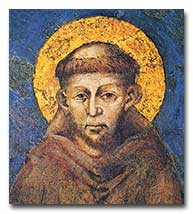
I just ran across an interesting site that you may enjoy and frequently visit. It is Franciscan Quote of the Day. The host posts an entry each day (more or less) from Franciscan writings or writers. Hope you will enjoy.
You can find it here.

 Posts
All Comments
Posts
All Comments


Life as a bishop—or at least the life of this bishop—does not leave much time to spend on poetry. But a few years ago a friend loaned me a volume of Rainer Maria Rilke, and of course, Rilke's work can be quite beautiful. In it, I found some lines of his verse that might help us begin our discussion today:
Slowly now the evening changes his garments
held for him by a rim of ancient trees;
you gaze: and the landscape divides and leaves you
one sinking and one rising toward the stars.And you are left, to none belonging wholly,
not so dark as a silent house, nor quite
so surely pledged unto eternity
as that which grows to star and climbs the night.To you is left (unspeakably confused)
your life, gigantic, ripening, full of fears,
so that it, now hemmed in, now grasping all,
is changed in you by turns to stone and stars.Philosophers and psychologists have offered a lot of different theories about the nature of the human person. But few have captured the human condition better than Rilke does in those twelve lines. We are creatures made for heaven; but we are born of this earth. We love the beauty of this world; but we sense there is something more behind that beauty. Our longing for that “something” pulls us outside of ourselves.
Striving for “something more” is part of the greatness of the human spirit, even when it involves failure and suffering. In the words of Venerable John Paul II, something in the artist, and by extension in all human beings, “mirrors the image of God as Creator.” We have an instinct to create beauty and new life that comes from our own Creator. Yet we live in a time when, despite all of our achievements, the brutality and indifference of the world have never been greater. The truth is that cruelty is also the work of human hands. So if we are troubled by the spirit of our age, if we really want to change the current course of our culture and challenge its guiding ideas—and this is the theme of our session here today—then we need to start with the author of that culture. That means examining man himself.
Culture exists because man exists. Men and women think, imagine, believe and act. The mark they leave on the world is what we call culture. In a sense, that includes everything from work habits and cuisine to social manners and politics. But I want to focus in a special way on those elements of culture that we consciously choose to create; things like art, literature, technology, music and architecture. These things are what most people think of when they first hear the word “culture.” And that makes sense, because all of them have to do with communicating knowledge that is both useful and beautiful. The task of an architect, for example, is to translate abstract engineering problems into visible, pleasing form; in other words, to turn disorder into order, and mathematical complexity into a public expression of strength and elegance. We are social animals. Culture is the framework within which we locate ourselves in relationship to other people, find meaning in the world and then transmit meaning to others.
In his 1999 Letter to Artists, John Paul II wrote that “beauty is the visible form of the good, just as the good is the metaphysical condition of beauty.” There is “an ethic, even a 'spirituality' of artistic service which contributes [to] the life and renewal of a people,” because “every genuine art form, in its own way, is a path to the inmost reality of man and of the world.”
He went on the say that “true art has a close affinity with the world of faith, so that even in situations where culture and the Church are far apart, art remains a kind of bridge to religious experience . . . Art by its nature is a kind of appeal to the mystery. Even when they explore the darkest depths of the soul or the most unsettling aspects of evil, artists give voice [to] the universal desire for redemption.”
Christianity is an incarnational religion. We believe that God became man. This has huge implications for how we live, and how we think about culture. God creates the world in Genesis. He judges it as “very good” (Gen 1:31). Later he enters the world to redeem it in the flesh and blood of his son (Jn 1:14). In effect, God licenses us to know, love and ennoble the world through the work of human genius. Our creativity as creatures is an echo of God's own creative glory. When God tells our first parents, “be fruitful and multiply, and fill the earth and subdue it” (Gen 1:28), he invites us to take part, in a small but powerful way, in the life of God himself.
The results of that fertility surround us. We see it in the great Christian heritage that still underpins the modern world. Anyone with an honest heart will grant that the Christian faith has inspired much of the greatest painting, music, architecture and scholarship in human experience. For Christians, art is a holy vocation with the power to elevate the human spirit and lead men and women toward God.
Having said all this, we still face a problem. And here it is: God has never been more absent from the Western mind than he is today. Additionally, we live in an age when almost every scientific advance seems to be matched by some increase of cruelty in our entertainment, cynicism in our politics, ignorance of the past, consumer greed, little genocides posing as “rights” like the cult of abortion, and a basic confusion about what—if anything at all—it means to be “human.”....
The Didache
"The second commandment of the teaching: You shall not murder. You shall not commit adultery. You shall not seduce boys. You shall not commit fornication. You shall not steal. You shall not practice magic. You shall not use potions. You shall not procure [an] abortion, nor destroy a newborn child" (Didache 2:1–2 [A.D. 70]).
The Letter of Barnabas
"The way of light, then, is as follows. If anyone desires to travel to the appointed place, he must be zealous in his works. The knowledge, therefore, which is given to us for the purpose of walking in this way, is the following. . . . Thou shalt not slay the child by procuring abortion; nor, again, shalt thou destroy it after it is born" (Letter of Barnabas 19 [A.D. 75-120]).
The Apocalypse of Peter
"And near that place I saw another strait place . . . and there sat women. . . . And over against them many children who were born to them out of due time sat crying. And there came forth from them rays of fire and smote the women in the eyes. And these were the accursed who conceived and caused abortion" (The Apocalypse of Peter 25 [A.D. 137]).
Athenagoras
"What man of sound mind, therefore, will affirm, while such is our character, that we are murderers?
. . . [W]hen we say that those women who use drugs to bring on abortion commit murder, and will have to give an account to God for the abortion, on what principle should we commit murder? For it does not belong to the same person to regard the very fetus in the womb as a created being, and therefore an object of God’s care, and when it has passed into life, to kill it; and not to expose an infant, because those who expose them are chargeable with child-murder, and on the other hand, when it has been reared to destroy it" (A Plea for the Christians 35 [A.D. 177]).


