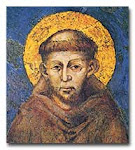
Showing posts with label Franciscan. Show all posts

Sunday, June 10, 2012

An Open Letter to My Brothers of the Franciscan First Order and to My Sisters in the Third Order Regular

I am scandalized by the presumptiveness of the leaders of the various First Order American Provinces in their recent press release of their support for the leadership of the Leadership Conference of Women Religions (LCWR) in light of the recent Doctrinal Assessment. I must ask, have you read the assessment? Had you, I cannot fathom how you could privately, let alone publicly, support these wayward ladies. Your support denigrates your own Order.

I approach you with as much humility as I can notwithstanding the extreme agitation and anxiety I am feeling over your leaders support contrary to the assessment. My own formation has taught me that when a brother or sister errors to approach them, in my love for you, so that you may amend yourselves.

In so an elementary foundation of our charism, the very teaching of Francis himself and by his example, by an expression of our humility and obedience and love, we are to be in union with the Magisterium of the Church. From where, in your vowed humility did this elitistism come? You put yourself before the Magisterium in support for the LCWR. Having the least compunction in scandalizing your brothers and sisters in the Orders, I must question your ability to properly lead them. You have fallen prey to the culture in which you live; one of hedonism and individualism.

We are called to be in conformity and give allegiance to the soul and heart of the Magisterium, as the assessment indicates.

Before I go further I extend my heartfelt appreciation for the instruction the nuns provided me, in concert with my parents, in establishing within me a love for God and my Faith. I would probably be a candidate for hell if it were not for them. I also extend my thanks to all the religious who have worked so tirelessly to bring to the world peace, charity, and social justice.

But Franciscanism, Father Francis, was not only about creation and peace and love – important as they are – but he was Christocentric and faithful to the Church and its teachings. Should we be anything less?

The assessment’s reports on the addresses given at the LCWR assemblies present a pattern of obstinacy to Church teaching. They dismiss their responsibility by saying they did not know the content of the presentations, but the pattern indicates their – if not spoken, their hidden – agenda. In addition, even if they were ill-informed as to the content of the talks, they remained unchallenged as brought to light in the assessment.

Their policies prove a corporate dissent of Church teaching: they protest the inability of the Church to ordain women; they embrace homosexuality, they continually take positions against the Church’s teachings on human sexuality. They present radical feminism and undermine our doctrines of the Holy Trinity, the divinity of Christ and the inspiration of Holy Scripture. They’re silent on right to life and natural death; they challenge positions taken by our Bishops who are our authentic teachers of faith and morals. To grant their wishes would mean to discard the essence of the Catholic Church’s Tradition. These are all serious concerns and I can only wonder and pray for the friars and religious who support the LCRW.

I understand on all our Orders there appear individuals with unorthodox ideas, opinions and agendas. But it seems these errors are pervasive. Part of the failure is in the formation process, the weeding out in the inquiry process. The infiltration of the radical liberalism in the Orders is an extremely dangerous situation. Rather than turning to Scripture and Teachings, our Rule, they are led by dissident voices who are not happy with the Church, the Order, or themselves. We are called to build the Church, not destroy it. If you are short of vocations ask yourself, why? Have you not seen the communities that are in-line with Church teaching, wear traditional values as well as their habit are thriving, while the others are dying?

My brothers and sisters need to turn back to our basic tenants of humility, obedience, and discipline. My love and prayers for them continues.

If you would like to read for yourself the Dogmatic Assessment, please go here.

Tuesday, February 7, 2012

OFS not SFO

Important information regarding the name of our Order

February 6, 2012

As some of you are aware, the Secular Franciscan Order holds its Chapter at the International level every three years (every other time, or every six years, is an elective chapter). The International Chapter in 2011 was at the same time as our National Chapter. One of the items that came out of that chapter is a directive from our Minister General, Encarnación del Pozo, regarding the letters we use after our names to indicate our membership in the Order. That letter from Encarnita is included below.

Following some discussion with the National Executive Council and my fellow Regional Ministers, I can summarize the effect of this letter in one sentence:

Effective immediately, we are to use “OFS” rather than “SFO” after our names.

Please note that the name of the Order does not change — English is one of the four official languages, and “Secular Franciscan Order” continues to be our name in English. This, in turn, means that other places where we use “SFO” as an abbreviation for “Secular Franciscan Order” — where it is not the three letters after our names — can stay the way they are. So, our national website will continue to be nafra-sfo.org, and our regional website will continue to be ilsfo.org, to name two examples.

If we consider the efforts of CIOFS to encourage a common sense of identity within the Secular Franciscan Order (something which is probably very clear to those of you who have been using the ongoing formation dossiers), it makes sense that all Secular Franciscans throughout the world, regardless of language, will henceforth use the same set of letters after our names to indicate our status as professed members of the Order. Yes, it will take some getting used to, but please accept that small sacrifice as part of your Lenten journey this year.

Above all, as our National Minister, Tom Bello, said to us when communicating this change, “… I am absolutely certain that OFS or SFO does not make me or you … any more or less Franciscan. We are still permanently professed. Our Order is still, in English, the Secular Franciscan Order.”

Peace and blessings to you all,

Vickie Klick, OFS
Regional Minister
{Mother Cabrini Region)

- – - – -

Allegato n. 9

ORDO FRANCISCANUS SÆCULARIS
XIII. GENERAL CHAPTER
Saõ Paulo, 2011. October 22-29

THE OFFICIAL NAME OF THE ORDER

THE USE AND THE TRANSLATION OF THE NAME OF THE ORDER

1. The official name of the Order is Ordo Franciscanus Sæcularis.

2. Translations of the name of the Order
2. 1 The translation of the name of the Order is already made in the four official languages, and these are the ones to be used in these languages, namely in Italian, in English, in Spanish and in French.
2.2 The name can be translated into local languages only when the literal translation from Latin is easily understandable even by the civil society and does not change its meaning or substance.
2.3 When the translation into the national language distorts the meaning of the name, or is linguistically impossible to transfer the genuine meaning, Ordo Franciscanus Sæcularis must always be used, which can be followed by expressions to clarify and make more understandable the nature of the Secular Franciscan Order to everyone in the local language.

3. The acronym
The acronym which refers to the name Ordo Franciscanus Sæcularis is OFS and is always to be used regardless of the language. For example, when Secular Franciscans use the acronym after their name, they must use “OFS”.

Encarnación del Pozo, OFS
General Minister

Thursday, June 16, 2011

Book Review - Parallel Lives by Richard F. Cassady


Excerpt:

By comparison, the achievement of Francis of Assisi marked a beginning rather than an end. It is true that Francis's dream of a monastic order that renounced the encumbrance and corruption of property was frustrated by the papacy and by his own successors. Mr. Cassady regards this as the destruction of Francis's work and points to the magnificent and costly double basilica at Assisi as the ultimate betrayal. But it is more complicated than that.

Although the Franciscans were obliged to accept a limited form of property holding, their founder's ideal of a group of missionaries living among the people but marked out from them by a simpler and purer way of life survived intact. The Franciscans transformed the spiritual life of 13th-century Europe, especially among the laity in the growing cities, very much as the Benedictines had transformed the spiritual life of a more rural society centuries before. Although the initial inspiration waned with the passing decades, as such inspirations always do, the Franciscans remained a significant influence on Christian spirituality until the Reformation, and their missionary work since the 16th century has been more impressive, over a longer period, than that of any other group.

Read the entire article here.

Sunday, March 20, 2011

Catholicism's best-kept secret: Third orders

Catholicism's best-kept secret: Third orders

Are you a Catholic who feels attracted to a religious order, but are married? Do you want to stay in your home and at your job, but still follow a rule of life, like that of St. Benedict, for example? Do you want to share your pilgrim journey with other like-minded people? Have I got a deal for you: Third orders!

Read the full post by Lisa, sfo of FranciscanFocus.com here.

Go the post for links to the various third orders.

H/T Franciscan Focus

Thursday, February 4, 2010

Franciscan Quote of the Day


I just ran across an interesting site that you may enjoy and frequently visit. It is Franciscan Quote of the Day. The host posts an entry each day (more or less) from Franciscan writings or writers. Hope you will enjoy.

You can find it here.

Thursday, January 28, 2010

Pope Benedict speaks of St. Francis

ON FRANCIS OF ASSISI

"The Secret of True Happiness: To Become Saints"

VATICAN CITY, JAN. 27, 2010 (Zenit.org).- Here is a translation of the address Benedict XVI gave today during the general audience in Paul VI Hall.

* * *

Dear brothers and sisters,

In a recent catechesis, I already illustrated the providential role that the Order of Friars Minor and the Order of Preachers, founded respectively by St. Francis of Assisi and St. Dominic Guzmán, had in the renewal of the Church of their time. Today I would like to present to you the figure of Francis, an authentic "giant" of holiness, who continues to fascinate very many people of every age and every religion.

"A son is born to the world." With these words, in the Divine Comedy (Paradiso, Canto XI), the greatest Italian poet, Dante Alighieri, alludes to Francis' birth, which occurred at the end of 1181 or the beginning of 1182, in Assisi. Belonging to a wealthy family -- his father was a textile merchant -- Francis enjoyed a carefree adolescence and youth, cultivating the chivalrous ideals of the time. When he was 20 he took part in a military campaign, and was taken prisoner. He became ill and was released. After his return to Assisi, a slow process of spiritual conversion began in him, which led him to abandon gradually the worldly lifestyle he had practiced until then.

Striking at this time are the famous episodes of the meeting with the leper -- to whom Francis, getting off his horse, gave the kiss of peace; and the message of the Crucifix in the little church of San Damiano. Three times the crucified Christ came to life and said to him: "Go, Francis, and repair my Church in ruins." This simple event of the Word of the Lord heard in the church of San Damiano hides a profound symbolism. Immediately, St. Francis is called to repair this little church, but the ruinous state of this building is a symbol of the tragic and disturbing situation of the Church itself at that time, with a superficial faith that does not form and transform life, with a clergy lacking in zeal, with the cooling off of love; an interior destruction of the Church that also implied a decomposition of unity, with the birth of heretical movements.

See the full article here.