Showing posts with label Saints. Show all posts

Tuesday, October 13, 2015

Aquinas 101


With deference to our Franciscan brother St. Bonaventure, I’ve been studying St. Thomas Aquinas’ thought, philosophy and theology for about a year now. I’ve finished reading the first of his five
volume Summa Theologiae.

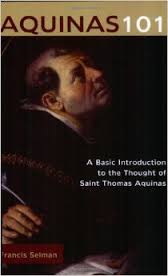
The Summa is difficult, but most of the difficulties lie in the volume of his works and in his terms. I say this because I just finished Aquinas 101 by Rev. Francis Selman, and I must say this is a terrific book to read if you have an interest in St. Thomas or what to know the basis of a lot of Catholic philosophy and theology. Selman presents St. Thomas in a very clear and easily understandable way. I feel greatly rewarded for having read it.

More so, I am impressed by the height of Thomas’ knowledge and his love for God which is clear in every paragraph he writes.


So impressed am I with this book, I’m considering facilitating a book discussion group in my parish.

Sunday, November 3, 2013

Archbishop Chaput on Sainthood

The meaning of sainthood: To be fully alive in Jesus Christ

By Archbishop Charles J. Chaput, O.F.M. Cap. 

Some years ago a friend told me that she secretly thought of the saints as boring. They smile at us sweetly from holy cards. Their lives can seem implausible compared to people more famous for their vices. And who would really want to be a saint, anyway? As Billy Joel once said, “I’d rather laugh with the sinners than cry with the saints. The sinners are much more fun.”

But when we come to understand holiness rightly, we see that it’s anything but boring. Sanctity isn’t a matter of sentimental posturing or being nice. Sanctity is about being passionately in love with Jesus Christ.


The saints are men and women who glowed white-hot with the Holy Spirit. They lived fully what Father Richard John Neuhaus once called “the high adventure of Christian discipleship.” And that’s truly what the heart of sainthood is: not a life of legalistic drudgery, but a high adventure.

Think about the women and men we venerate as saintly: Mother Teresa, Francis Xavier, King Louis IX of France, Gianna Beretta Molla, Pier Giorgio Frassati, Catherine of Siena. They lived some of the most compelling lives in history. Their roads were hard. They endured great sacrifices and self-denial. But those sacrifices led to greater love and joy than many in the world have ever known.

If we think about sainthood like that, it can seem like the saints are a special class of people. Sainthood is for people like them, we think, not everyday people like us. And how do you live like a saint if you’re just an ordinary worker, a father or a mother? The good news is that the saints were ordinary people like us. Their “secret” was not something they possessed, but Someone who possessed them....
Read the rest here.

Sunday, July 14, 2013

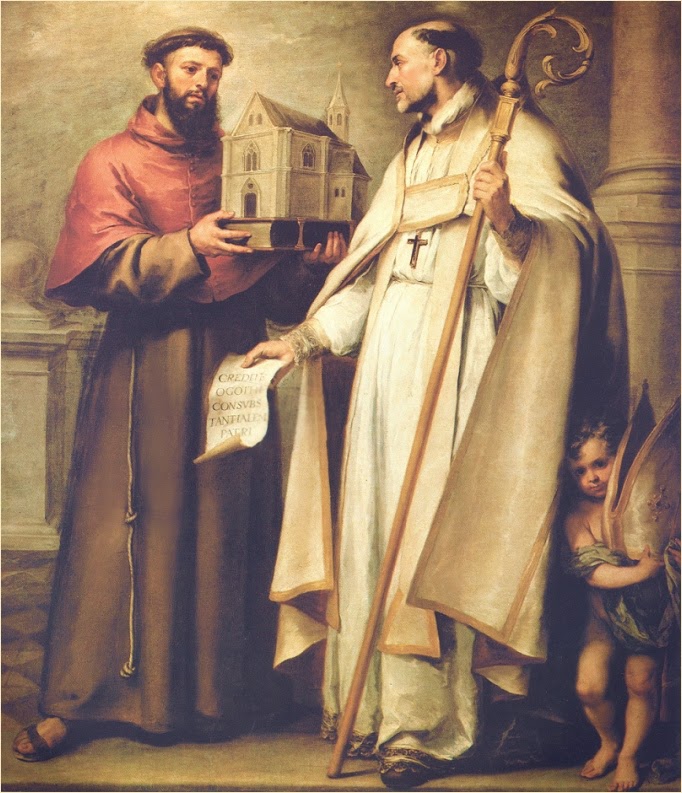
St. Bonaventure (Cardinal-bishop, Doctor of the Church) - July 15


From the Proper Offices of Franciscan Saints in the Liturgy of the Hours:

Almighty God, as we celebrate the birthday of Saint Bonaventure the bishop grant us the grace to profit frim his excellent teaching and always to imitate the ardor of his love. We ask this through our Lord Jesis Christ, your Son, who lives and reigns with you and the Holy Spitit, one God, for ever and ever.

From Wikipedia:

Life
He was born at Bagnoregio in Latium, not far from Viterbo, then part of the Papal States. Almost nothing is known of his childhood, other than the names of his parents, Giovanni di Fidanza and Maria Ritella.

He entered the Franciscan Order in 1243 and studied at the University of Paris, possibly under Alexander of Hales, and certainly under Alexander's successor, John of Rochelle. In 1253 he held the Franciscan chair at Paris. Unfortunately for Bonaventure, a dispute between seculars and mendicants delayed his reception as Master until 1257, where his degree was taken in company with Thomas Aquinas. Three years earlier his fame had earned him the position of lecturer on the The Four Books of Sentences—a book of theology written by Peter Lombard in the twelfth century—and in 1255 he received the degree of master, the medieval equivalent of doctor.

After having successfully defended his order against the reproaches of the anti-mendicant party, he was elected Minister General of the Franciscan Order. On 24 November 1265, he was selected for the post of Archbishop of York; however, he was never consecrated and resigned the appointment in October 1266. It was by his order that Roger Bacon, a Franciscan friar himself, was interdicted from lecturing at Oxford and compelled to put himself under the surveillance of the Order at Paris.

Bonaventure was instrumental in procuring the election of Pope Gregory X, who rewarded him with the title of Cardinal Bishop of Albano, and insisted on his presence at the great Council of Lyon in 1274. There, after his significant contributions led to a union of the Greek and Latin churches, Bonaventure died suddenly and in suspicious circumstances. The Catholic Encyclopedia has citations which suggest he was poisoned. The only extant relic of the saint is the arm and hand with which he wrote his Commentary on the Sentences, which is now conserved at Bagnoregio, in the parish church of St. Nicholas.

He steered the Franciscans on a moderate and intellectual course that made them the most prominent order in the Catholic Church until the coming of the Jesuits. His theology was marked by an attempt completely to integrate faith and reason. He thought of Christ as the “one true master” who offers humans knowledge that begins in faith, is developed through rational understanding, and is perfected by mystical union with God.

From the Catholic Company:

St. Bonaventure is clearly a marvelous saint, but what makes him relevant today? St. Bonaventure taught a very important lesson during his life which must continue to be taught. He proposed that theology can only be done rightly with love of God and desire of union with him. Essentially what this means is that theology ought to be a practical science. Theology cannot or should not simply be thinking about God and who or what he is. Theology done rightly will lead one to a deeper piety and love of God. I think, and Bonaventure would probably agree with me, that today many theologians do not engage theology in the practical way St. Bonaventure advocates for. I find that this results in some off the wall theological ideas and arguments. St. Bonaventure’s ideas still need to be remembered for anyone who seeks to learn more about who God is and what he is, or other theological inquiries.
Read the rest here.

Monday, September 5, 2011

St. Thomas More - Moral Integrity


I ran across a posting by the Pennsylvania Catholic Conference on Thomas More. In these times of political corruption and a lack of integrity in a secular society we need to look at men like Thomas and pray for statesmen who exhibit and live as examples of moral integrity, that objective truths do exist.

The article starts:

Today we celebrate the tenth anniversary of the Apostolic Letter (Motu Proprio) of Pope John Paul II proclaiming Saint Thomas More as the patron of statesmen, politicians and lawyers. Together with the people of the Commonwealth of Pennsylvania, we call to mind the significance of this great saint of the 16th Century for us today.

St. Thomas More lived—and gave his life—for truth. He provides a powerful example that not only shows that objective truth exists, but that we have the God-given ability to discern it. He stands as an example showing all statesmen, politicians and lawyers—and indeed all of us—that we have an obligation to find and to serve the truth and to work to protect the lives and fundamental dignity of all human beings.

In 1929, the great Catholic writer, G.K. Chesterton, wrote that: “Thomas More is more important at this moment than at any moment since his death, even perhaps the great moment of his dying. But he is not quite so important as he will be in about a hundred years’ time.”....

On October 31, 2000, Pope John Paul II issued an Apostolic Letter in which he proclaimed Saint Thomas More to be the patron of statesmen, politicians and lawyers. In that letter, the Pope proclaimed:

“The life and martyrdom of Saint Thomas More have been the source of a message which spans the centuries and which speaks to people everywhere of the inalienable dignity of the human conscience, which, as the Second Vatican Council reminds us, is ‘the most intimate centre and sanctuary of a person, in which he or she is alone with God, whose voice echoes within them.’ (Gaudium et Spes, 16).

Whenever men or women heed the call of truth, their conscience then guides their actions reliably towards good. Precisely because of the witness which he bore, even at the price of his life, to the primacy of truth over power, Saint Thomas More is venerated as an imperishable example of moral integrity.”

See the entire posting here.

Sunday, July 26, 2009

St. Caesarius of Arles - Sermon 5

In continuing to read St. Caesarius's sermons I find yet another entitled "An Admonition that, for the Salvation of One's Soul, Harsh Preaching Not Only Should Not Be Rejected, But Should Even Be Sought with Ardent Longing".

Seldom, in fact hardly ever, do I hear a strong sermon, or as we say today, homily. Pastors today, it would seem, are afraid to call their parishoners from sin for fear of loosing their Sunday collection. But as St. Caesarius would say we go to doctors to heal our bodily ills and at some times at great paid. But we are not willing to accept a strong word to heal our soul.

If you would like to read this sermon see the link below. It is in Word 2007.

Saturday, July 25, 2009

St. Caesarius of Arles

I've just become acquainted with St. Caesarius of Arles. I have been reading the volumn on Mark in the "Ancient Christian Commentary on Scripture: series. In this series they take the various passages from the Bible and insert passages from the writings of the Church Fathers that relate to the text.

I've found it interesting to see what the various Fathers have said about the passages in Scripture. In doing so I've seen some selections from Caesarius of Arles, who I have not heard of before. So I did a little research via the internet and found some of his sermons.

In reading Sermon 1 I found it quite interesting as one of my pet peeves is what I call 'la la' homilies. In this sermon Caesarius exhorts his fellow bishops and priests to preach more often and at Mass as well. I guess in the Sixth Century it was not common for Priests to give homilies at Mass.

Having found this sermon rewarding, I thought I would share it. See the link below. Excuse any errors as I had to convert it from a pdf file to Word 2007.