
Showing posts with label New Evangelization. Show all posts

Monday, July 1, 2013

‘We Need to Be Active Witnesses of Our Faith’

I love Archbishop Chaput. He always seems to hit the nail on the head. On June 22 he gave a speech honoring St. Junipero Serra. He speaks of our mission, the new evangelization, St. Francis and Fr. Serra. It is excellent. Below is an excerpt. I hope it encourages you to read the whole speech. It can be found here.
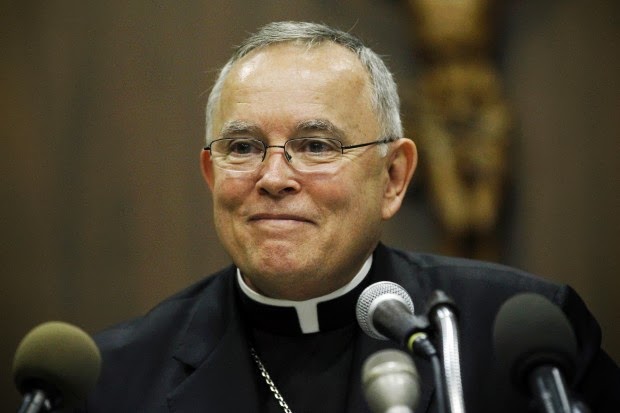

The “how” of a New Evangelization, or any evangelization, needs to begin with our own repentance and conversion. That hasn’t changed since Father Serra walked the Camino Real, the trail that linked California’s missions. We can’t give what we don’t have. 
As individuals, we control very little in life; but we do control what we do with our hearts.  We can at least make ourselves available to God as his agents. Personal conversion is the essential first step. It immediately affects the people around us. 
The “how” also requires us to understand the real human terrain we’re called to convert. 

Christian Smith, Notre Dame’s distinguished social researcher, suggests that the de facto dominant religion among American teenagers today is “moralistic therapeutic deism.” And he frames the creed of this new religion in this way:

First, a God exists who created and orders the world and watches over human life on earth. Second, God wants people to be good, nice and fair to each other, as taught in the Bible and most world religions. Third, the central goal of life is to be happy and to feel good about oneself. Fourth, God doesn’t need to be particularly involved in one’s life, except when he’s needed to fix a problem. And, fifth, good people go to heaven when they die.

“Teen religion” largely derives from the world of adult religion, especially parental religion, and it flows naturally from what the parents of these teens actually practice.  Old patterns of religious faith among many adults have faded into a kind of vague “spirituality,” which then shapes the world into which American adolescents are socialized.

For many young people, the moralistic part of “moralistic therapeutic deism” simply means being pleasant and responsible, working on “self-improvement,” taking care of one’s health and doing one’s best to succeed. “Therapeutic” means focusing on feeling good and happy, being secure and at peace. It’s about subjective well-being and getting along amiably with other persons. And “deism” means that God exists — he created our world — but he’s not particularly involved in our affairs, especially when we don’t want him around. He’s available to meet our needs. He’s not demanding on us, but we can be demanding on him.

Obviously, very little of this has anything to do with the Gospel of Jesus Christ or the faith of the martyrs. And that’s a problem.
In practice, American society now breeds a kind of radical self-focus and practical atheism — not by refuting faith in God, but by rendering God irrelevant to people’s needs and urgencies of the moment. 

As Christopher Lasch saw in The Culture of Narcissism, consumer culture tends to create weak personalities dependent on group behavior and approval — and therefore more susceptible to advertising and product consumption. The hard and social sciences replace the clergy as a source of guidance and meaning. And social media and mass entertainment abolish solitude and personal reflection.  

So, in an age of massive self-absorption, the result is that real individuality and self-mastery are withering. Why? Because the communities that root and shape an individual in distinctive moral codes and histories — in other words, our families, churches, synagogues and fraternal organizations — can’t compete with the noise and flash of consumer society.

Here’s what that means for all of us as believers:  A “new” evangelization must start with the sober knowledge that much of the once-Christian developed world, and even many self-described Christians, are in fact pagan. 

Christian faith is not a habit. It’s not a useful moral code. It’s not an exercise in nostalgia. It’s a restlessness, a consuming fire in the heart to experience the love of Jesus Christ and then share it with others — or it’s nothing at all.

Mastering the new social and demographic data that describe today’s world, and the new communications tools to reach it, are vitally important for the Church. 


But nothing can be accomplished if we lack faith and zeal ourselves. We — and that means you and I — are the means God uses to change the world. The material tools are secondary. People, not things, are decisive.

Sunday, June 30, 2013

We Want to be Taught

I just became aware of a site that is encouraging the Magisterium to implement an Ordinary Sunday catechetical lectionary. Here is what I commented on the site:

“I am extremely aware of the need for catechesis for the people in the pews. I can site many reasons, but here are a few: 1) Unless self-motivated Catholics receive no continuing formation after religious studies in grammar school, or for the lucky ones high school; 2) I've often commented on the "la la" homilies especially in liberal dioceses; and 3) Catholics are strongly influenced by the secular culture in which they live, contrary to church teaching and filled with misinformation from the media, and they don't even realize it.”

I encourage everyone to go to this site and learn more: http://www.wewanttobetaught.com/

There has been a lot of talk about the new evangelization; evangelization needs to start within ourselves, then within our local parish communities, then to the world at large.


Do you not see the need Christ has for you, as does His church? At this time when we are trying to protect our religious rights and support the efforts of Fortnight for Freedom, it is necessary for all of us to pray, inform ourselves, take action and be heard.

Sunday, January 27, 2013

The Year of Faith, The New Evangelization


From time to time I have been posting something that relates to the Year of Faith and the New Evangelization. By our Baptism and Confirmation we are all called to spread the Gospel. This is a most urgent need as we are living in a culture that is contrary to our beliefs in so many ways. As Francis says, and if I may paraphrase – we are to preach the Gospel at all times and when necessary to use words.

Family, friends, neighbors and our co-workers should know we are practicing Catholics. We should not be afraid to mention our faith or church teachings to others, we can mention it in normal social conversations, we can teach others our beliefs in conversations about issues. We do not need to brow-beat others, but by example urge them to consider their relationship with God. If we show how much our faith means to us, they just might get it.

We cannot evangelize/attract others if we do not show them our enthusiasm, our joy in our faith. We will not attract anyone if we are dour or overly pious. We need to show them we are real people who are searching and messing things up just as they. We can’t just preach to the choir. At times we need to get our hands dirty and break bread, as Jesus did, with tax collectors and prostitutes; read the un-churched, the pro-abortionists, the hedonists, materialists, individualists, etc.

The new evangelization does not take us on missionary journeys to the far reaches of the world, but occurs in our workplaces, social gatherings, backyards, and even in our own homes; and perhaps as important, within ourselves. For we need to evaluate and ask ourselves, “Am I living the gospel life?” Are we shy in bringing up our faith in our own families? We need to educate ourselves not only with scripture reading, but we need to know and relearn our catechism and church teachings. If not, we will not be able to add to conversations especially in the areas of morals and values.

More is accomplished over a dinner table, or a group discussion than that of any number of dignitaries and experts meeting for weeks to issue documents and statements of position.

If we truly care about our brothers, sisters, family, friends, neighbors, co-workers – and we are taught our enemies as well – then we must be willing to share our faith and help bring them to everlasting life.

Below is an excerpt from article by Cardinal Wuerl on the Year of Faith and the New Evangelization I ran across in Our Sunday Visitor. I hope it has some meaning for you.


Experiencing Christ through the sacraments
The Church and its sacraments are a continual reminder to us of God, God’s love and God’s place in our lives
By Cardinal Donald Wuerl - OSV Newsweekly, 1/27/2013

Each year, couples from all over the archdiocese gather at a Mass in which we recognize their anniversaries, ranging from 25th to 50th and beyond. On rare occasions we have celebrated 70th wedding anniversaries. 

[ Deleted upon request....]
Read the rest of the article here.

Saturday, November 24, 2012

Book Recommendation: Will Many Be Saved

This book was recommended to me. Though I have not read it yet, I did run across an article about it in Our Sunday Visitor Catholic Newspaper. I think it is an important topic for our times.
It starts:

Author explains urgency of New Evangelization Book explores Vatican II teaching about salvation and how it relates to evangelization efforts today.

By Mary DeTurris Poust - OSV Newsweekly, 11/25/2012
Knowing who will or will not get into heaven is a tricky subject for most people of faith, but author Ralph Martin tackles it head on in his new book, “Will Many Be Saved? What Vatican II Actually Teaches and Its Implications for the New Evangelization” ($24, William B. Eerdmans Publishing Co.). Martin recently spoke to Our Sunday Visitor via email from Rome, where he was serving as a theological expert during the Synod of Bishops on the New Evangelization.
Our Sunday Visitor: Why did you feel this book was necessary at this time?
Ralph Martin: I’ve been concerned for a long time that a presumption that virtually everyone is saved has taken hold in the minds of many Catholics. This obviously undermines motivation for evangelization, not to mention holiness and obedience to the Word of God. The teaching of Vatican II has been very much misunderstood on this point, and the book tries to clearly and decisively set the record straight. It is, indeed, possible under certain conditions for those who have never heard the Gospel to be saved, but as the Constitution on the Church from Vatican II says in Section 16, “very often” these conditions are not met and peoples’ salvations are at risk unless they hear the Gospel and respond.
OSV: We hear the term “New Evangelization” a lot in the Church today, and yet I think many Catholics are still unsure of what that means. Can you explain “New Evangelization” to the person in the pew?
Martin: First of all let’s define evangelization. I think the best definition I know is that given by Blessed John Paul II in his encyclical “Mission of the Redeemer” (Redemptoris Missio):
“The proclamation of the Word of God has Christian conversion (in original) as its aim: a complete and sincere adherence to Christ and his Gospel through faith ... Conversion means accepting, by a personal decision, the saving sovereignty of Christ and becoming his disciple” (No. 46).
Evangelization in its broad sense can refer to everything that the Church does, but the core definition has to do with conversion — helping people come to faith in Christ and surrender their lives to him.
The best definition of “New Evangelization” is again given by Blessed John Paul II in his encyclical. He makes a threefold distinction. Primary evangelization is directed toward those who have never heard the Gospel before. Pastoral care is directed toward those living in some relationship with Christ. “New Evangelization or re-evangelization” is directed toward those from traditionally Christian cultures or backgrounds “where entire groups of the baptized have lost a living sense of the faith, or even no longer consider themselves members of the Church, and live a life far removed from Christ and his Gospel” (No. 33).
The New Evangelization is new in whom it is addressed to, those who may have been baptized or practiced their faith at one time, but now are no longer living a relationship of friendship with Christ. It is also new in terms of who does it: us! And it is new in the cultural situation in which it is conducted — a de-Christianized culture where respect for God and his ways are no longer honored, but rather mocked and attacked.
This doesn’t mean we all need to be preachers. Evangelization can be a very simple sharing of our faith with someone who asks a question; or passing on a book on the spiritual life to someone who would benefit from reading it; or inviting someone who would benefit by hearing more about the faith to a parish mission talk, etc.
Read the rest here.