Thursday, April 18, 2013

Taxes


Taxes

When NASA first started sending up astronauts, they quickly discovered that ball-point pens would not work in zero gravity. To combat this problem, NASA scientists spent a decade and $12 billion developing a pen that writes in zero gravity, upside down, on almost any surface including glass and at temperatures ranging from below freezing to over 300 degrees.

The Russians used a pencil.

Enjoy paying your taxes, they're due again!

Sunday, April 14, 2013

Take A look at "Your Social Security check" 2013

I received this in an email and thought I would share it, so everyone can have a reality check.

SOCIAL SECURITY becomes FEDERAL BENEFIT CHECK

Have you noticed, the Social Security check is now referred to as a "Federal  Benefit  Payment"?

I'll be part of the one percent to forward this. I am forwarding it because it touches a nerve in me, and I hope it will in you. Please keep passing it on until everyone in our country has read it.

The government is now referring to our Social Security checks as a Federal Benefit Payment. This isn't a benefit, it is earned income! Not only did we all contribute to Social Security but our employers did too.

It totaled 15% of our income before taxes. If you averaged $30K per year over your working life, that's close to $180,000 invested in Social Security.

If you calculate the future value of your monthly investment in social security ($375/month, including both you and your employers contributions) at a meager 1% interest rate compounded monthly, after 40 years of working you'd have more than $1.3+ million dollars saved!

This is your personal investment. Upon retirement, if you took out only 3% per year, you'd receive $39,318 per year, or $3,277 per month.

That's almost three times more than todays average Social Security benefit of $1,230 per month, according to the Social Security Administration (Google it - its a fact).

And your retirement fund would last more than 33 years (until you're 98 if you retire at age 65)! I can only imagine how much better most average-income people could live in retirement if our government had
just invested our money in low-risk interest-earning accounts.

Instead, the folks in Washington pulled off a bigger Ponzi scheme than Bernie Madoff ever did. They took our money and used it elsewhere. They forgot that it was OUR money they were taking. They didn't have a referendum to ask us if we wanted to lend the money to them. And they didn't pay interest on the debt they assumed. And recently, they've told us that the money won't support us for very much longer. But is it our fault they misused our investments?

And now, to add insult to injury, they're calling it a benefit, as if we never worked to earn every penny of it.  Just because they borrowed the money, doesn't mean that our investments were a charity!

Lets take a stand. We have earned our right to Social Security and Medicare. Demand that our legislators bring some sense into our government. Find a way to keep Social Security and Medicare going, for the sake of that 92% of our population who need it.

* Then call it what it is: Our Earned Retirement Income. *

Friday, April 12, 2013

Logic

Saturday, April 6, 2013


Sometimes there seems to be so much to keep up with, and sometimes things fall through the cracks. I just learned that there is an official Proper for Blessed John Paul II and his feast day is October 22 as promulgated by the Congregation for Divine Worship.

For Morning and Evening prayer only the Collect is Proper. All the rest comes from the Common of Pastors, For a Pope. And if you do the Office of Readings there is a Reading.

It can be found on the USCCB site, but to save you some effort I’ve copied it below.


BLESSED JOHN PAUL II, POPE
Common of Pastors: For a Pope.

Collect
O God, who are rich in mercy
and who willed that the blessed John Paul the Second
should preside as Pope over your universal Church,
grant, we pray, that instructed by his teaching,
we may open our hearts to the saving grace of Christ,
the sole Redeemer of mankind.
Who lives and reigns.

BLESSED JOHN PAUL II, POPE

Charles Joseph Wotjtyła was born in 1920 in Wadowice, Poland. After his ordination to the priesthood and theological studies in Rome, he returned to his homeland and resumed various pastoral and academic tasks. He became first auxiliary bishop and, in 1964, Archbishop of Krakow and took part in the Second Vatican Council. On 16 October 1978 he was elected pope and took the name John Paul II. His exceptional apostolic zeal, particularly for families, young people and the sick, led him to numerous pastoral visits throughout the world. Among the many fruits which he has left as a heritage to the Church are above all his rich Magisterium and the promulgation of the Catechism of the Catholic Church as well as the Code of Canon Law for the Latin Church and for the Eastern Churches. In Rome on 2 April 2005, the eve of the Second Sunday of Easter (or of Divine Mercy), he departed peacefully in the Lord.

Common of Pastors: For a Pope.

Office of readings

Second reading

From the Homily of Blessed John Paul II, Pope, for the Inauguration of his Pontificate
(22 October 1978: AAS 70 [1978], 945-947)

Do not be afraid. Open wide the doors for Christ.
Peter came to Rome! What else but obedience to the inspiration received from the Lord could have guided him and brought him to this city, the heart of the Empire? Perhaps the fisherman of Galilee did not want to come here. Perhaps he would have preferred to stay there, on the shores of Lake of Genesareth, with his boat and his nets. Yet guided by the Lord, obedient to his inspiration, he came here!

According to an ancient tradition, Peter tried to leave Rome during Nero’s persecution. However, the Lord intervened and came to meet him. Peter spoke to him and asked. “Quo vadis, Domine?” — “Where are you going, Lord?” And the Lord answered him at once: “I am going to Rome to be crucified again.” Peter went back to Rome and stayed here until his crucifixion.

Our time calls us, urges us, obliges us, to gaze on the Lord and to immerse ourselves in humble and devout meditation on the mystery of the supreme power of Christ himself.

He who was born of the Virgin Mary, the carpenter’s Son (as he was thought to be), the Son of the living God (as confessed by Peter), came to make us all “a kingdom of priests”.

The Second Vatican Council has reminded us of the mystery of this power and of the fact that Christ’s mission as Priest, Prophet-Teacher and King continues in the Church. Everyone, the whole People of God, shares in this threefold mission. Perhaps in the past the tiara, that triple crown, was placed on the Pope’s head in order to signify by that symbol the Lord’s plan for his Church, namely that all the hierarchical order of Christ’s Church, all “sacred power” exercised in the Church, is nothing other than service, service with a single purpose: to ensure that the whole People of God shares in this threefold mission of Christ and always remains under the power of the Lord; a power that has its source not in the powers of this world, but instead in the mystery of the Cross and the Resurrection.

The absolute, and yet sweet and gentle, power of the Lord responds to the whole depths of the human person, to his loftiest aspirations of intellect, will and heart. It does not speak the language of force, but expresses itself in charity and truth.

The new Successor of Peter in the See of Rome today makes a fervent, humble and trusting prayer: Christ, make me become and remain the servant of your unique power, the servant of your sweet power, the servant of your power that knows no dusk. Make me a servant: indeed, the servant of your servants.
Brothers and sisters, do not be afraid to welcome Christ and accept his power. Help the Pope and all those who wish to serve Christ and with Christ’s power to serve the human person and the whole of mankind.
Do not be afraid. Open, I say open wide the doors for Christ. To his saving power open the boundaries of states, economic and political systems, the vast fields of culture, civilization and development. Do not be afraid. Christ knows “that which is in man”. He alone knows it.

So often today, man does not know that which is in him, in the depths of his mind and heart. So often he is uncertain about the meaning of his life on this earth. He is assailed by doubt, a doubt which turns into despair. We ask you, therefore, we beg you with humility and with trust, let Christ speak to man. He alone has words of life, yes, of life eternal.

Responsory
R/. Do not be afraid. The Redeemer of mankind has revealed the power of the Cross and has given his life for us. * Open, open wide the doors for Christ.
V/. In the Church we are called to partake of his power. * Open, open wide the doors for Christ.

Oration
O God, who are rich in mercy and who willed that the blessed John Paul the Second should preside as Pope over your universal Church, grant, we pray, that instructed by his teaching, we may open our hearts to the saving grace of Christ, the sole Redeemer of mankind. Who lives and reigns.
Wednesday, March 13, 2013

Pope Francis


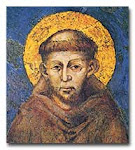
I got the word at work that there was white smoke. I immediately went to Fox News Live on my computer. It was not long afterward that it was announced that Jorge Mario Bergoglio was elected Pope and that he took the name Francis. Well there was some dancing around in elation, literally. Terrific. How great! How great that before he gave his first papal blessing, he bowed and asked for our prayers and blessing. Rome, perhaps the whole world, fell silent for those few moments. Heaven was bombarded in prayer.

Francis. How wonderful he took the name Francis. We know a Pope chooses a name that will define himself and his papacy. Perhaps these traits of Saint Francis that he sees defines him are not the same that I envision. But here us what I see:


Rebuild My Church
This was my first thought. I believe Pope Francis sees this as his mission. As in St. Francis’ time our church today needs rebuilding. I don’t know much about the Roman Curia, but I think it needs some work. The tone was set in Pope Francis humbly first asking us for our prayers and bowing to receive them – a fine example to all those in the Vatican. We are still reeling from the shock of Vatican II. Yes, so very much needed. But it started a huge ball running downhill in liberalism. I’ve seen corrective action by Blessed John Paul II the Great, and Pope Benedict. But it is hard to stop something going downhill. Pope Francis will continue the corrective action. This will flow through the Cardinals who pledged their loyalty, to the dioceses around the world, to the parishes, and to us. How fortuitous in the Year of Faith and the New Evangelization.

Humility and Poverty
This was my second thought. We know how Francis embraced Lady Poverty. I expect Pope Francis will do the same. Pope Francis we already know took public transportation and lived in an apartment instead of a mansion. I don’t think he will/can do the same in Rome, but I think he will be an example to all the other prelates. I don’t think, I hope, he will sell off the Vatican treasures, but his example will remind us that we don’t need that much, that we can share our resources with others.

Peace
St. Francis was a great unifier. I see the same in Pope Francis’ papacy.

Of course I am no prophet. Perhaps this is wishful thinking. But what stands out over everything is the name he chose; Francis. This tells me a lot. This was not a thoughtless decision. This most definitely will set his identity and agenda. I am very positive and hopeful. The Holy Spirit has done a good job.


Friday, March 1, 2013

Sunday, February 24, 2013

Facing the Storm


Deacon Ken of my parish had this article in today’s bulletin. A good lesson – thought I would share it.

Tom

FACING THE STORM
When I was going through my chemo treatments two years ago I was feeling quite down, so my Pastor friend from Hayward Wisconsin told me a little story to get my spirits up and I would like to share that with you here. A Wyoming cowboy was once asked, what was the greatest lesson he'd learned from his experiences of ranching? “The Herefords taught me one of life's most important lessons,” he replied. “We used to breed cattle for a living, but the winter storms would come and kill 'em off. It would take a terrible toll on the herd. “Time and time again, after a cold winter storm, we'd find most of our cattle piled up against the fences, dead as doornails. They would turn their backs to the icy wind, and slowly drift downward until the fences stopped them. There, they just piled up and died.” “But the Herefords were different than that,” he continued. “They would head straight into the wind and slowly walk the other way until they came to the upper boundary fence where they stood, facing the storm. “We always found our Herefords alive and well. They saved their hides by facing the storm.” When the storms of life are raging, our natural inclination is to duck and hide. It is easier to turn our backs on reality than to face the brutal facts. The path of least resistance, however, is a deadly course. Instead, we must face the storm head-on. When a problem arises in your life, you have to face it before you can fix it. Facing life's storms brings renewed strength, hope and power for living:
1. Facing the storm strengthens character. People who have never experienced any hardship tend to go all to pieces whenever troubles arise. “Oh no. The sky is falling.” If the sky falls on you a few times, and you're still kicking, you realize that you can make it. You are too big of a person to let the little problems get you. One day, when I was in a jam, a good friend remarked, “Not to worry - Your ship was made to sail in seas like these.”
2. Facing the storm sweetens the spirit. The sweetest people I've ever met are those who have endured much hardship.
3. Facing the storm deepens compassion. When we suffer, we are more able to identify with others who are hurting.
4. Facing the storm broadens the horizon. Hardship helps us to look forward to better days. It makes us realize that our current situation isn't forever, this world is not our home, and the best is yet to come. I hope this helps some of you who are facing some difficult situations.

Friday, February 22, 2013

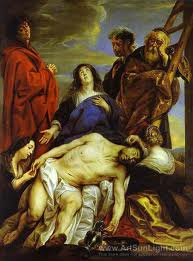
The Pietà


I prayed the Way of the Cross tonight, St. Alphonsus’ method (the best Way, in my opinion).  I was amazed my focus fell on Jesus being taken down from the cross into His mother’s arms, the thirteenth station. Usually this station does not get any more attention than the others. But tonight it hit me. You have to read between the Gospel lines; we know Mary was there and the Gospel accounts say that she followed Joseph of Arimathaea and Nicodemus to the sepulcher, it is only the station that tells us Jesus was placed in His mother’s arms.

And so my visualization expanded. We don’t like to think about it, but Jesus was naked. Some will insist that Jesus was covered by a cloth, but this is not the way the Romans worked. A crucifixion took away every ounce of dignity. I’m sure He was immediately covered as Mary’s arms received Him. And what her anguish must have been holding her son’s lifeless, torn and bloody body. She had witnessed the torment helplessly. I can hear her moan of anguish. I can see the expression on her face. She is not aware of those who surround her, Mary Magdalene, the other Mary, Salome, and others in feeble attempt to comfort. She trembles as her love emanates from her to her son.

After a while He was taken from her, carried/carted to the sepulcher as she followed. How could she even walk supported by the other women, though not far, as Calvary and the holy sepulcher are both within the Church of the Holy Sepulcher? And we know that Mary, assisted by the others anointed Jesus’s body, placed his arms, and arranged the shroud. She left, the tomb was closed.

 And once again, as at the Nativity, I’m sure she pondered these things in her heart.


Sunday, February 17, 2013

RCIA Notes


Last night I was preparing for an RCIA class I will be helping with this morning. I thought I would share these thoughts with my Franciscan family and other friends as well. These notes are my thoughts in response to the topic “Saying Yes to Jesus”

  • Christ has called you. How will you respond?
  • Review the events you expect to happen in your life tomorrow. Choose one, examine it.
    • I will go to 10 AM Mass. Although not my usual time, I probably will see some of the people I know from St Stephen’s, some who share in the same ministries. For example Barb, perhaps Sue, and others. It is always good to see them, for after spending the week among the seculars, it is good to see others who share my faith. And I will help out with the RCIA class. It is important to me because it is the little thing I do for others, mostly to share my enthusiasm for my faith. We are an Easter people, without being overly confident or presumptuous we should be overjoyed by this as eternity awaits us.
    • I could be lazy and not go to church. That does nothing for me, as it would be a lost opportunity to give my creator due praise, worship and thanksgiving with my faith community. Every ministry, no matter how small, or of little impact, has its rewards.
  • I will, but first…
    • Although I was not born yet when WWII came about, I know from history how so many Americans responded to the call. I’m sure you are aware of the Uncle Sam posters with the words “I want you.” There might be someone in immediate distress, a child for example, falling in a pond. We respond immediately, without hesitation. Likewise, at different times God calls us. Some of us are born into the faith but we do not hear a call until later in life. You, as well, are responding to God’s call in your own way, in God’s time. Do we respond whole heartedly? Or do we go through the motions. Being called is nothing less than a great blessing. It is like our response when a friend asks us to help him move, or an elderly person needing a ride to a doctor.
    • When our interest is peaked to join some organization or other, we don’t just “join”. For example, my calling to be a Franciscan. The first step is discernment and education. I thought about having a Franciscan vocation, I learned about it. So you have discerned  becoming a Catholic, or living your faith more fully. I don’t just attend Mass on Sunday’s but I live my faith and my Franciscan vocation. If you decide to become a Boy Scout leader, you don’t just attend meetings, you learn how to become a leader, you share your enthusiasm, you give your time, talent and treasure.
    • The more active you are in your faith the more rewarding it is.
  • This is a Hard Saying…
    • By its nature the Catholic faith is counter-cultural. We are called to lead a life different than many of our neighbors. In many ways we have become indoctrinated in the secular culture in which we live. But following our faith brings unimaginable rewards.
    • We are very hedonistic, individualistic, since the sixties we have rejected authority. So at times we find conflict with church teaching.  A lot of Jesus’ sayings are hard: “forgive seventy times seven times?” “love your enemies?” “give aid to the Samaritan – read stranger – someone different?” “Don’t kill babies?” We tend to think we know it all. But church teaching is based on two thousand years’ experience, and in this time there have been many great thinkers and teachers. How can I think my conclusions are better than what the church teaches? We are so lucky to have the teaching authority of the church to guide our lives, so we make the correct decisions that will lead to a happy life and eventually salvation. Humanae Vitae was not crafted to make life for Catholics difficult, it was prophetic. Many didn’t like the changes of Vatican II, but the church has been blessed for it. Even today, the church asks us to look to the Year of Faith and to the new evangelization. And those of us who address these calls are that much more happier for it.
  • He went away sad…
    • Jesus told the young man to sell all he had, give to the poor and follow him, because he wanted to change the young man’s primary focus. Our primary focus should be on Jesus and our faith, our spiritual well-being.
    • I am often dismayed when I see so many others spending so much on their diet, health, and material possessions. They worry about their physical, mental, and emotional health, but spend little or no time looking to their spiritual health – the most important.
    • Even a hard working family man with his concerns for his wife and children and job needs to focus on his and their faith. We will drive our children to this and that event, class, sport, shopping, yet we will not read the bible together or have a family night of discussion.

Tuesday, February 12, 2013

Pope Benedict's Resignation & God Creation and Free Will


I thought I would write a few thought about my reaction to the news about Pope Benedict. I am as shocked as anyone over the announcement that Pope Benedict will retire at the end of February. I’ve been telling myself over and over “I can’t believe it.” It is shocking because it just doesn’t happen; it is as if we suddenly saw a cat fly. Actually, the last Pope to resign was Pope Gregory XII who stepped down amid the Great Western Schism in 1415. At the time there were three men claiming to be leader of the Catholic Church.

I liken Pope Benedict to be a lot like Pope St. Gregory the Great who was a monk and did not want to be pope. Benedict is a theologian, I believe he sees himself slowing down, he is 86, and is being humble enough to say he can’t keep up. Have you seen a pope’s schedule? I think Pope Benedict will retire to some obscure monastery and do what theologians do.

As for me, I’m staying away from the media as I know they are going to be looking for sensational stories, comments from the far left - they have already done N.C.R., and they will make a lot of speculations.

In truth, this is all under control by the Holy Spirit. We should pray for Pope Benedict and the conclave Cardinals.

The church has been tremendously blessed by the pontificate of Benedict and his writings. A latest example follows. I believe this lesson is filled with food for thought. Perhaps, you may want to read this slowly and find the richness and Truth found here - a good way to start our Lenten journey.


Benedict’s General Audience 2/6/12 - God, Creation and Free Will.
Dear Brothers and Sisters,
the Creed, which begins by describing God as "Almighty Father", then continues that he is the "Creator of heaven and earth", repeating the affirmation with which the Bible begins. In the first verse of Sacred Scripture, we read: "In the beginning God created the heavens and the earth" (Genesis 1:1) God is the source of all things and in the beauty of creation unfolds His omnipotence as a loving Father.

God is manifested as Father in creation, as the origin of life, and, in creating shows His omnipotence. The images used in Sacred Scripture in this regard are very suggestive (cf. Is 40.12, 45.18, 48.13, Ps 104,2.5, 135.7, Pr 8, 27-29; Gb 38-39). Like a good and powerful Father, He takes care of what He has created with a love and loyalty that are never lacking (cf. Ps 57.11, 108.5, 36.6). Thus, Creation becomes a place in which to know and recognize the omnipotence of the Lord and His goodness, and becomes a call to faith for believers because we proclaim God as Creator. "By faith, - writes the author of the Letter to the Hebrews - we understand that the worlds were framed by the word of God, so that the visible world was made out of the invisible" (11.3). Faith implies, therefore, being able to recognize the invisible, by identifying traces of it in the visible world. The believer can read the great book of nature and understanding its language (cf. Ps 19.2 to 5), the universe speaks to us of God (cf. Rom 1:19-20), but we need the Word of His revelation, that stimulates faith, so that man can achieve full awareness of the reality of God as Creator and Father. In the book of Sacred Scripture human intelligence can find, in the light of faith, the interpretative key to understanding the world. The first chapter of Genesis holds a particularly special place, with the solemn presentation of the Divine creative action unfolding along seven days: in six days God brings Creation to completion and the seventh day, the Sabbath, ceases all activity and rests. The Day of freedom for all, the day of communion with God and so with this, the Book of Genesis tells us that God's first thought was to find a love that responds to His love. The second thought is then to create a material world to place this love in, these creatures who freely respond to Him. This structure means that the text is marked by some significant repetitions. Six times, for example, the phrase is repeated: "God saw that it was good" (vv. 4.10.12.18.21.25), and finally, the seventh time, after the creation of man: "God looked at everything he had made, and found it very good"(v. 31).

Everything that God creates is good and beautiful, full of wisdom and love, the creative action of God brings order, infuses harmony, gives beauty. In the Genesis it thus emerges that the Lord creates by His word: for ten times "God said" is stated in the text (vv. 3.6.9.11.14.20.24.26.28.29), emphasizing the effective power of God's Word. As the Psalmist sings: "By the word of the Lord the heavens were made, by the breath of his mouth all their host ... because he spoke and all things were created, commanded, and it was done" (33,6.9). Life pours forth, the world exists, because everything obeys the Word of God.

But our question today is does it make sense in the age of science and technology, to still speak of creation? How should we understand the narratives of Genesis? The Bible is not intended as a manual of the natural sciences; it wants to help us understand the authentic and profound truth of things. The fundamental truth that the stories of Genesis reveal is that the world is not a collection of contrasting forces, but has its origin and its stability in the Logos, the eternal reason of God, who continues to sustain the universe. There is a design of the world that is born from this Reason, the Spirit Creator. Believing that this is at the basis of all things, illuminates every aspect of life and gives us the courage to face the adventure of life with confidence and hope. So the Scripture tells us that the origin of the world, our origin is not irrational or out of necessity, but reason and love and freedom. And this is the alternative: the priority of the irrational, of necessity or the priority of reason, freedom and love. We believe in this position.

But I would like to say a word about what is the apex of all creation: man and woman, the human being, the only ones "capable of knowing and loving their Creator" (Pastoral Constitution. Gaudium et Spes, 12). The Psalmist watching the skies asks: "When I see your heavens, the work of your fingers, the moon and stars that you set in place, What are humans that you are mindful of them, mere mortals that you care for them? "(8.4 to 5). The human being, created with love by God, is a small thing in front of the immensity of the universe, and sometimes, fascinated as we watch the huge expanses of the sky, we too perceive our limitations. The human being is inhabited by this paradox: his smallness and transience living with the magnitude of what the eternal love of God has willed for him.

The stories of creation in Genesis also introduce us to this mysterious area, helping us to know God's plan for man. First of all they affirm that God formed man of the dust of the earth (cf. Gen 2:7). This means that we are not God, we did not make ourselves, we are the earth, but it also means that we come from good soil, through the work of the Creator. Added to this is another fundamental reality: all human beings are dust, beyond the distinctions of culture and history, beyond any social difference; we are one humanity formed with the sole earth of God. Then there is a second element: the human being originates because God breathes the breath of life into the body he molded from the earth (cf. Gen 2:7). The human being is made in the image and likeness of God (cf. Gen 1:26-27). And we all carry within us the breath of life from God and every human life - the Bible tells us - is under the special protection of God. This is the deepest reason for the inviolability of human dignity against any attempt to evaluate the person in accordance with utilitarian criteria or those of power. Being the image and likeness of God means that man is not closed in on himself, but has an essential reference in God.

In the first chapters of Genesis are two significant images: the garden with the tree of knowledge of good and evil and the serpent (cf. 2:15-17; 3,1-5). The garden tells us that the reality in which God has placed the human being is not a wild forest, but a place that protects, nourishes and sustains, and the man must recognize the world not as his property to be plundered and exploited, but as gift of the Creator, a sign of His saving will, a gift to cultivate and care for, to grow and develop in accordance and harmony with the rhythms and logic of God’s plan (cf. Gen 2.8 to 15). The snake is a figure derived from the oriental cults of fertility, which fascinated Israel and were a constant temptation to abandon the mysterious covenant with God. In the light of this, the Bible presents the temptation of Adam and Eve as the core of temptation and sin. What does the snake say? He does not deny God, but slips in a subtle question: "Is it true that God said" You shall not eat of any tree of the garden? '"(Gen 3:1). In this way, the snake raises the suspicion that the covenant with God is like a chain that binds, which deprives of liberty and the most beautiful and precious things in life. The temptation becomes that of building their own world in which to live, not to accept the limitations of being a creature, the limits of good and evil, morality; dependence on the creating love of God is seen as a burden to be freed of. This is always the crux of the matter. But when the relationship with God is distorted, by our putting ourselves in His place, all other relationships are altered. Then the other becomes a rival, a threat: Adam, having succumbed to the temptation, immediately accuses Eve (cf. Gen 3:12), and the two hide from the sight of that God with whom they spoke as friends (see 3.8 - 10), the world is no longer a garden to live in harmony, but a place to be exploited and of hidden pitfalls (cf. 3:14-19); envy and hatred towards each other enter into man's heart: the example of Cain who kills his brother Abel (cf. 4.3 to 9). Going against his Creator, man actually goes against himself, denies his origin and therefore his truth, and evil enters into the world, with its painful chain of pain and death. And if all that God created was good, indeed very good, after man’s free decision in favor of lies over the truth, evil entered the world.

I would like to highlight one last instruction from the stories of creation: sin begets sin and the sins of history are interlinked. This aspect pushes us to discuss that which is termed "original sin." What is the meaning of this reality, often difficult to understand? I would like to illustrate some elements. First, we must consider that no man is closed in on itself, no man can live only in and of himself; we receive life from the other and not only at birth, but every day. The human being is relational: I am myself only in you and through you, the relationship of love with the You of God and the you of others. Well, sin upsets or destroys our relationship with God, its presence destroys our relationship with God, the fundamental relationship, when we put ourselves in Gods place. The Catechism of the Catholic Church states that with the first sin, man, "chose himself over and against God, against the requirements of his creaturely status and therefore against his own good."(n. 398).

Once the fundamental relationship is upset, the other poles of relationships are compromised or destroyed, sin ruins everything. Now, if the relational structure of humanity is troubled from the start, every man walks into a world marked by the disturbance of this relationship, enters a world disturbed by sin, by which he is marked personally; the initial sin attacks and injures human nature (cf. Catechism of the Catholic Church, 404-406). And man can not get out of this situation alone, he can not redeem himself alone, only the Creator can restore the right relationship. Only if the One from which we have strayed comes to us and takes us by the hand with love, can the right relationship be re-woven. This happens in Jesus Christ, who takes the exact opposite path to that of Adam, as the hymn in the second chapter of the Letter of St. Paul to the Philippians describes (2:5-11): while Adam does not recognize his being a creature and wants to put himself in the place of God, Jesus, the Son of God, is in a perfect filial relationship with the Father, he lowers himself, becomes the servant, he travels the path of love humbling himself to death on the Cross, to reorder relations with God. The Cross of Christ becomes the new Tree of Life.

Dear brothers and sisters, to live by faith is to recognize the greatness of God and accept our smallness, our condition as creatures letting the Lord fill us with His love. Evil, with its load of pain and suffering, is a mystery that is illuminated by the light of faith, which gives us the certainty of being able to be freed from it, the certainty that it is good to be human.