Sunday, February 24, 2013

Facing the Storm


Deacon Ken of my parish had this article in today’s bulletin. A good lesson – thought I would share it.

Tom

FACING THE STORM
When I was going through my chemo treatments two years ago I was feeling quite down, so my Pastor friend from Hayward Wisconsin told me a little story to get my spirits up and I would like to share that with you here. A Wyoming cowboy was once asked, what was the greatest lesson he'd learned from his experiences of ranching? “The Herefords taught me one of life's most important lessons,” he replied. “We used to breed cattle for a living, but the winter storms would come and kill 'em off. It would take a terrible toll on the herd. “Time and time again, after a cold winter storm, we'd find most of our cattle piled up against the fences, dead as doornails. They would turn their backs to the icy wind, and slowly drift downward until the fences stopped them. There, they just piled up and died.” “But the Herefords were different than that,” he continued. “They would head straight into the wind and slowly walk the other way until they came to the upper boundary fence where they stood, facing the storm. “We always found our Herefords alive and well. They saved their hides by facing the storm.” When the storms of life are raging, our natural inclination is to duck and hide. It is easier to turn our backs on reality than to face the brutal facts. The path of least resistance, however, is a deadly course. Instead, we must face the storm head-on. When a problem arises in your life, you have to face it before you can fix it. Facing life's storms brings renewed strength, hope and power for living:
1. Facing the storm strengthens character. People who have never experienced any hardship tend to go all to pieces whenever troubles arise. “Oh no. The sky is falling.” If the sky falls on you a few times, and you're still kicking, you realize that you can make it. You are too big of a person to let the little problems get you. One day, when I was in a jam, a good friend remarked, “Not to worry - Your ship was made to sail in seas like these.”
2. Facing the storm sweetens the spirit. The sweetest people I've ever met are those who have endured much hardship.
3. Facing the storm deepens compassion. When we suffer, we are more able to identify with others who are hurting.
4. Facing the storm broadens the horizon. Hardship helps us to look forward to better days. It makes us realize that our current situation isn't forever, this world is not our home, and the best is yet to come. I hope this helps some of you who are facing some difficult situations.

Friday, February 22, 2013

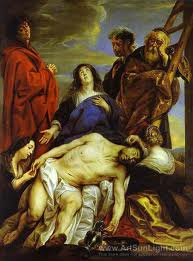
The Pietà


I prayed the Way of the Cross tonight, St. Alphonsus’ method (the best Way, in my opinion).  I was amazed my focus fell on Jesus being taken down from the cross into His mother’s arms, the thirteenth station. Usually this station does not get any more attention than the others. But tonight it hit me. You have to read between the Gospel lines; we know Mary was there and the Gospel accounts say that she followed Joseph of Arimathaea and Nicodemus to the sepulcher, it is only the station that tells us Jesus was placed in His mother’s arms.

And so my visualization expanded. We don’t like to think about it, but Jesus was naked. Some will insist that Jesus was covered by a cloth, but this is not the way the Romans worked. A crucifixion took away every ounce of dignity. I’m sure He was immediately covered as Mary’s arms received Him. And what her anguish must have been holding her son’s lifeless, torn and bloody body. She had witnessed the torment helplessly. I can hear her moan of anguish. I can see the expression on her face. She is not aware of those who surround her, Mary Magdalene, the other Mary, Salome, and others in feeble attempt to comfort. She trembles as her love emanates from her to her son.

After a while He was taken from her, carried/carted to the sepulcher as she followed. How could she even walk supported by the other women, though not far, as Calvary and the holy sepulcher are both within the Church of the Holy Sepulcher? And we know that Mary, assisted by the others anointed Jesus’s body, placed his arms, and arranged the shroud. She left, the tomb was closed.

 And once again, as at the Nativity, I’m sure she pondered these things in her heart.


Sunday, February 17, 2013

RCIA Notes


Last night I was preparing for an RCIA class I will be helping with this morning. I thought I would share these thoughts with my Franciscan family and other friends as well. These notes are my thoughts in response to the topic “Saying Yes to Jesus”

  • Christ has called you. How will you respond?
  • Review the events you expect to happen in your life tomorrow. Choose one, examine it.
    • I will go to 10 AM Mass. Although not my usual time, I probably will see some of the people I know from St Stephen’s, some who share in the same ministries. For example Barb, perhaps Sue, and others. It is always good to see them, for after spending the week among the seculars, it is good to see others who share my faith. And I will help out with the RCIA class. It is important to me because it is the little thing I do for others, mostly to share my enthusiasm for my faith. We are an Easter people, without being overly confident or presumptuous we should be overjoyed by this as eternity awaits us.
    • I could be lazy and not go to church. That does nothing for me, as it would be a lost opportunity to give my creator due praise, worship and thanksgiving with my faith community. Every ministry, no matter how small, or of little impact, has its rewards.
  • I will, but first…
    • Although I was not born yet when WWII came about, I know from history how so many Americans responded to the call. I’m sure you are aware of the Uncle Sam posters with the words “I want you.” There might be someone in immediate distress, a child for example, falling in a pond. We respond immediately, without hesitation. Likewise, at different times God calls us. Some of us are born into the faith but we do not hear a call until later in life. You, as well, are responding to God’s call in your own way, in God’s time. Do we respond whole heartedly? Or do we go through the motions. Being called is nothing less than a great blessing. It is like our response when a friend asks us to help him move, or an elderly person needing a ride to a doctor.
    • When our interest is peaked to join some organization or other, we don’t just “join”. For example, my calling to be a Franciscan. The first step is discernment and education. I thought about having a Franciscan vocation, I learned about it. So you have discerned  becoming a Catholic, or living your faith more fully. I don’t just attend Mass on Sunday’s but I live my faith and my Franciscan vocation. If you decide to become a Boy Scout leader, you don’t just attend meetings, you learn how to become a leader, you share your enthusiasm, you give your time, talent and treasure.
    • The more active you are in your faith the more rewarding it is.
  • This is a Hard Saying…
    • By its nature the Catholic faith is counter-cultural. We are called to lead a life different than many of our neighbors. In many ways we have become indoctrinated in the secular culture in which we live. But following our faith brings unimaginable rewards.
    • We are very hedonistic, individualistic, since the sixties we have rejected authority. So at times we find conflict with church teaching.  A lot of Jesus’ sayings are hard: “forgive seventy times seven times?” “love your enemies?” “give aid to the Samaritan – read stranger – someone different?” “Don’t kill babies?” We tend to think we know it all. But church teaching is based on two thousand years’ experience, and in this time there have been many great thinkers and teachers. How can I think my conclusions are better than what the church teaches? We are so lucky to have the teaching authority of the church to guide our lives, so we make the correct decisions that will lead to a happy life and eventually salvation. Humanae Vitae was not crafted to make life for Catholics difficult, it was prophetic. Many didn’t like the changes of Vatican II, but the church has been blessed for it. Even today, the church asks us to look to the Year of Faith and to the new evangelization. And those of us who address these calls are that much more happier for it.
  • He went away sad…
    • Jesus told the young man to sell all he had, give to the poor and follow him, because he wanted to change the young man’s primary focus. Our primary focus should be on Jesus and our faith, our spiritual well-being.
    • I am often dismayed when I see so many others spending so much on their diet, health, and material possessions. They worry about their physical, mental, and emotional health, but spend little or no time looking to their spiritual health – the most important.
    • Even a hard working family man with his concerns for his wife and children and job needs to focus on his and their faith. We will drive our children to this and that event, class, sport, shopping, yet we will not read the bible together or have a family night of discussion.

Tuesday, February 12, 2013

Pope Benedict's Resignation & God Creation and Free Will


I thought I would write a few thought about my reaction to the news about Pope Benedict. I am as shocked as anyone over the announcement that Pope Benedict will retire at the end of February. I’ve been telling myself over and over “I can’t believe it.” It is shocking because it just doesn’t happen; it is as if we suddenly saw a cat fly. Actually, the last Pope to resign was Pope Gregory XII who stepped down amid the Great Western Schism in 1415. At the time there were three men claiming to be leader of the Catholic Church.

I liken Pope Benedict to be a lot like Pope St. Gregory the Great who was a monk and did not want to be pope. Benedict is a theologian, I believe he sees himself slowing down, he is 86, and is being humble enough to say he can’t keep up. Have you seen a pope’s schedule? I think Pope Benedict will retire to some obscure monastery and do what theologians do.

As for me, I’m staying away from the media as I know they are going to be looking for sensational stories, comments from the far left - they have already done N.C.R., and they will make a lot of speculations.

In truth, this is all under control by the Holy Spirit. We should pray for Pope Benedict and the conclave Cardinals.

The church has been tremendously blessed by the pontificate of Benedict and his writings. A latest example follows. I believe this lesson is filled with food for thought. Perhaps, you may want to read this slowly and find the richness and Truth found here - a good way to start our Lenten journey.


Benedict’s General Audience 2/6/12 - God, Creation and Free Will.
Dear Brothers and Sisters,
the Creed, which begins by describing God as "Almighty Father", then continues that he is the "Creator of heaven and earth", repeating the affirmation with which the Bible begins. In the first verse of Sacred Scripture, we read: "In the beginning God created the heavens and the earth" (Genesis 1:1) God is the source of all things and in the beauty of creation unfolds His omnipotence as a loving Father.

God is manifested as Father in creation, as the origin of life, and, in creating shows His omnipotence. The images used in Sacred Scripture in this regard are very suggestive (cf. Is 40.12, 45.18, 48.13, Ps 104,2.5, 135.7, Pr 8, 27-29; Gb 38-39). Like a good and powerful Father, He takes care of what He has created with a love and loyalty that are never lacking (cf. Ps 57.11, 108.5, 36.6). Thus, Creation becomes a place in which to know and recognize the omnipotence of the Lord and His goodness, and becomes a call to faith for believers because we proclaim God as Creator. "By faith, - writes the author of the Letter to the Hebrews - we understand that the worlds were framed by the word of God, so that the visible world was made out of the invisible" (11.3). Faith implies, therefore, being able to recognize the invisible, by identifying traces of it in the visible world. The believer can read the great book of nature and understanding its language (cf. Ps 19.2 to 5), the universe speaks to us of God (cf. Rom 1:19-20), but we need the Word of His revelation, that stimulates faith, so that man can achieve full awareness of the reality of God as Creator and Father. In the book of Sacred Scripture human intelligence can find, in the light of faith, the interpretative key to understanding the world. The first chapter of Genesis holds a particularly special place, with the solemn presentation of the Divine creative action unfolding along seven days: in six days God brings Creation to completion and the seventh day, the Sabbath, ceases all activity and rests. The Day of freedom for all, the day of communion with God and so with this, the Book of Genesis tells us that God's first thought was to find a love that responds to His love. The second thought is then to create a material world to place this love in, these creatures who freely respond to Him. This structure means that the text is marked by some significant repetitions. Six times, for example, the phrase is repeated: "God saw that it was good" (vv. 4.10.12.18.21.25), and finally, the seventh time, after the creation of man: "God looked at everything he had made, and found it very good"(v. 31).

Everything that God creates is good and beautiful, full of wisdom and love, the creative action of God brings order, infuses harmony, gives beauty. In the Genesis it thus emerges that the Lord creates by His word: for ten times "God said" is stated in the text (vv. 3.6.9.11.14.20.24.26.28.29), emphasizing the effective power of God's Word. As the Psalmist sings: "By the word of the Lord the heavens were made, by the breath of his mouth all their host ... because he spoke and all things were created, commanded, and it was done" (33,6.9). Life pours forth, the world exists, because everything obeys the Word of God.

But our question today is does it make sense in the age of science and technology, to still speak of creation? How should we understand the narratives of Genesis? The Bible is not intended as a manual of the natural sciences; it wants to help us understand the authentic and profound truth of things. The fundamental truth that the stories of Genesis reveal is that the world is not a collection of contrasting forces, but has its origin and its stability in the Logos, the eternal reason of God, who continues to sustain the universe. There is a design of the world that is born from this Reason, the Spirit Creator. Believing that this is at the basis of all things, illuminates every aspect of life and gives us the courage to face the adventure of life with confidence and hope. So the Scripture tells us that the origin of the world, our origin is not irrational or out of necessity, but reason and love and freedom. And this is the alternative: the priority of the irrational, of necessity or the priority of reason, freedom and love. We believe in this position.

But I would like to say a word about what is the apex of all creation: man and woman, the human being, the only ones "capable of knowing and loving their Creator" (Pastoral Constitution. Gaudium et Spes, 12). The Psalmist watching the skies asks: "When I see your heavens, the work of your fingers, the moon and stars that you set in place, What are humans that you are mindful of them, mere mortals that you care for them? "(8.4 to 5). The human being, created with love by God, is a small thing in front of the immensity of the universe, and sometimes, fascinated as we watch the huge expanses of the sky, we too perceive our limitations. The human being is inhabited by this paradox: his smallness and transience living with the magnitude of what the eternal love of God has willed for him.

The stories of creation in Genesis also introduce us to this mysterious area, helping us to know God's plan for man. First of all they affirm that God formed man of the dust of the earth (cf. Gen 2:7). This means that we are not God, we did not make ourselves, we are the earth, but it also means that we come from good soil, through the work of the Creator. Added to this is another fundamental reality: all human beings are dust, beyond the distinctions of culture and history, beyond any social difference; we are one humanity formed with the sole earth of God. Then there is a second element: the human being originates because God breathes the breath of life into the body he molded from the earth (cf. Gen 2:7). The human being is made in the image and likeness of God (cf. Gen 1:26-27). And we all carry within us the breath of life from God and every human life - the Bible tells us - is under the special protection of God. This is the deepest reason for the inviolability of human dignity against any attempt to evaluate the person in accordance with utilitarian criteria or those of power. Being the image and likeness of God means that man is not closed in on himself, but has an essential reference in God.

In the first chapters of Genesis are two significant images: the garden with the tree of knowledge of good and evil and the serpent (cf. 2:15-17; 3,1-5). The garden tells us that the reality in which God has placed the human being is not a wild forest, but a place that protects, nourishes and sustains, and the man must recognize the world not as his property to be plundered and exploited, but as gift of the Creator, a sign of His saving will, a gift to cultivate and care for, to grow and develop in accordance and harmony with the rhythms and logic of God’s plan (cf. Gen 2.8 to 15). The snake is a figure derived from the oriental cults of fertility, which fascinated Israel and were a constant temptation to abandon the mysterious covenant with God. In the light of this, the Bible presents the temptation of Adam and Eve as the core of temptation and sin. What does the snake say? He does not deny God, but slips in a subtle question: "Is it true that God said" You shall not eat of any tree of the garden? '"(Gen 3:1). In this way, the snake raises the suspicion that the covenant with God is like a chain that binds, which deprives of liberty and the most beautiful and precious things in life. The temptation becomes that of building their own world in which to live, not to accept the limitations of being a creature, the limits of good and evil, morality; dependence on the creating love of God is seen as a burden to be freed of. This is always the crux of the matter. But when the relationship with God is distorted, by our putting ourselves in His place, all other relationships are altered. Then the other becomes a rival, a threat: Adam, having succumbed to the temptation, immediately accuses Eve (cf. Gen 3:12), and the two hide from the sight of that God with whom they spoke as friends (see 3.8 - 10), the world is no longer a garden to live in harmony, but a place to be exploited and of hidden pitfalls (cf. 3:14-19); envy and hatred towards each other enter into man's heart: the example of Cain who kills his brother Abel (cf. 4.3 to 9). Going against his Creator, man actually goes against himself, denies his origin and therefore his truth, and evil enters into the world, with its painful chain of pain and death. And if all that God created was good, indeed very good, after man’s free decision in favor of lies over the truth, evil entered the world.

I would like to highlight one last instruction from the stories of creation: sin begets sin and the sins of history are interlinked. This aspect pushes us to discuss that which is termed "original sin." What is the meaning of this reality, often difficult to understand? I would like to illustrate some elements. First, we must consider that no man is closed in on itself, no man can live only in and of himself; we receive life from the other and not only at birth, but every day. The human being is relational: I am myself only in you and through you, the relationship of love with the You of God and the you of others. Well, sin upsets or destroys our relationship with God, its presence destroys our relationship with God, the fundamental relationship, when we put ourselves in Gods place. The Catechism of the Catholic Church states that with the first sin, man, "chose himself over and against God, against the requirements of his creaturely status and therefore against his own good."(n. 398).

Once the fundamental relationship is upset, the other poles of relationships are compromised or destroyed, sin ruins everything. Now, if the relational structure of humanity is troubled from the start, every man walks into a world marked by the disturbance of this relationship, enters a world disturbed by sin, by which he is marked personally; the initial sin attacks and injures human nature (cf. Catechism of the Catholic Church, 404-406). And man can not get out of this situation alone, he can not redeem himself alone, only the Creator can restore the right relationship. Only if the One from which we have strayed comes to us and takes us by the hand with love, can the right relationship be re-woven. This happens in Jesus Christ, who takes the exact opposite path to that of Adam, as the hymn in the second chapter of the Letter of St. Paul to the Philippians describes (2:5-11): while Adam does not recognize his being a creature and wants to put himself in the place of God, Jesus, the Son of God, is in a perfect filial relationship with the Father, he lowers himself, becomes the servant, he travels the path of love humbling himself to death on the Cross, to reorder relations with God. The Cross of Christ becomes the new Tree of Life.

Dear brothers and sisters, to live by faith is to recognize the greatness of God and accept our smallness, our condition as creatures letting the Lord fill us with His love. Evil, with its load of pain and suffering, is a mystery that is illuminated by the light of faith, which gives us the certainty of being able to be freed from it, the certainty that it is good to be human.
Sunday, January 27, 2013

The Year of Faith, The New Evangelization


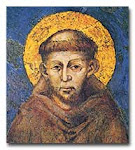
From time to time I have been posting something that relates to the Year of Faith and the New Evangelization. By our Baptism and Confirmation we are all called to spread the Gospel. This is a most urgent need as we are living in a culture that is contrary to our beliefs in so many ways. As Francis says, and if I may paraphrase – we are to preach the Gospel at all times and when necessary to use words.

Family, friends, neighbors and our co-workers should know we are practicing Catholics. We should not be afraid to mention our faith or church teachings to others, we can mention it in normal social conversations, we can teach others our beliefs in conversations about issues. We do not need to brow-beat others, but by example urge them to consider their relationship with God. If we show how much our faith means to us, they just might get it.

We cannot evangelize/attract others if we do not show them our enthusiasm, our joy in our faith. We will not attract anyone if we are dour or overly pious. We need to show them we are real people who are searching and messing things up just as they. We can’t just preach to the choir. At times we need to get our hands dirty and break bread, as Jesus did, with tax collectors and prostitutes; read the un-churched, the pro-abortionists, the hedonists, materialists, individualists, etc.

The new evangelization does not take us on missionary journeys to the far reaches of the world, but occurs in our workplaces, social gatherings, backyards, and even in our own homes; and perhaps as important, within ourselves. For we need to evaluate and ask ourselves, “Am I living the gospel life?” Are we shy in bringing up our faith in our own families? We need to educate ourselves not only with scripture reading, but we need to know and relearn our catechism and church teachings. If not, we will not be able to add to conversations especially in the areas of morals and values.

More is accomplished over a dinner table, or a group discussion than that of any number of dignitaries and experts meeting for weeks to issue documents and statements of position.

If we truly care about our brothers, sisters, family, friends, neighbors, co-workers – and we are taught our enemies as well – then we must be willing to share our faith and help bring them to everlasting life.

Below is an excerpt from article by Cardinal Wuerl on the Year of Faith and the New Evangelization I ran across in Our Sunday Visitor. I hope it has some meaning for you.


Experiencing Christ through the sacraments
The Church and its sacraments are a continual reminder to us of God, God’s love and God’s place in our lives
By Cardinal Donald Wuerl - OSV Newsweekly, 1/27/2013

Each year, couples from all over the archdiocese gather at a Mass in which we recognize their anniversaries, ranging from 25th to 50th and beyond. On rare occasions we have celebrated 70th wedding anniversaries. 

[ Deleted upon request....]
Read the rest of the article here.

Monday, January 21, 2013

2 Tough Questions


2 TOUGH QUESTIONS


Question 1: 
If you knew a woman who was pregnant, 
Who had 8 kids already, 
Three who were deaf, 
Two who were blind, 
One mentally retarded, 
And she had syphilis, 
Would you recommend that she undergoes an abortion? 

Read the next question before looking at the response for this one. 

Question 2: 
It is time to elect a new world leader, and only your vote counts.. 
Here are the facts about the three candidates. 
  
Candidate A: 
Associates with crooked politi cians, and consults with astrologists. 
He's had two mistresses. 
He also chain smokes 
And drinks 8 to 10 martinis a day. 
  
Candidate B: 
He was kicked out of office twice, 
Sleeps until noon, 
Used opium in college 
And drinks a quart of whiskey every evening. 
  
Candidate C: 
He is a decorated war hero, 
He's a vegetarian, 
Doesn't smoke, 
Drinks an occasional beer 
And never committed adultery. 
  
  
Which of these candidates would be your choice? 
  
Decide first ... No peeking, and then scroll down for the response. 


Candidate A is Franklin D. Roosevelt. 
Candidate B is Winston Churchill. Candidate C is Adolph Hitler. 
  
And, by the way, on your answer to the abortion question: 
  
If you said YES, you just killed Beethoven. 
  
  
Pretty interesting isn't it? 
Makes a person think before judging someone. 
  
  
Remember: 
  
Amateurs ... Built the ark. 
Professionals ... Built the Titanic 


Sunday, January 13, 2013

Endless Love

I ran across this article in the current issue of National Right to Life News and thought I would share it. It is now 40 years since Roe vs. Wade legalizing abortion. Perhaps this year you can make an effort to support the Pro-Life efforts and perhaps make a donation to a pro-life organization like the National Right to Life Committee, http://www.nrlc.org, or a crisis pregnancy center. We have seen, we feel the effects abortion on demand has had on the devaluing of human life; each life formed in the image of God, each life a gift from God, each life of equal value and you or I.

 
NRL News
Page 3
Winter 2013
Volume 40
Issue 1
Endless Love

By Carol Tobias

As the right-to-life movement enters the 40th year of legalized abortion on demand in our country, it’s appropriate to look at the current state of affairs. Fifty-five million children have been killed by abortion. It’s difficult to comprehend that number. Almost 18% of our entire population, that number is equal to the population of the entire middle portion of the country. It’s almost the population of New York and California.

How different our country would be today if those 20- and 30-somethings were working, maybe creating jobs for others, getting married and raising children of their own. Grandchildren are missing, having been erased from the family tree. Women are hurting, knowing they cannot reverse the decision that took from them a part of their own life.

Our loss of respect for the innocent human life of that, oh so little, unborn child has created a mindset that no human life is special. If some elderly person is taking up necessary space in a hospital or nursing home, let’s determine that food and water are medical treatment and consider them to be unnecessary. Is a disabled person taking up too many medical resources and not giving enough back to the state? Deny him or her treatment.

Sometimes it seems that our society cares more about animals than people. Witness the television commercials asking for support to save abused dogs and cats. Don’t humans deserve as much compassion? Shouldn’t humans get even more?

As pro-lifers, how do we respond? As I look at who we are and what we do, I think that can be summed up in one word—LOVE.

The right-to-life movement is the movement of love. Most of us have attended a wedding where those famous words from 1 Corinthians, chapter 13, are read:

Love is patient and kind; love does not envy or boast; it is not arrogant or rude. It does not insist on its own way; it is not irritable or resentful; it does not rejoice at wrongdoing, but rejoices with the truth. Love bears all things, believes all things, hopes all things, endures all things. Love never ends.

While those words are wonderful for a couple looking to spend the rest of their lives together, how much more appropriate are they for those who seek to help and protect others simply because those others exist.

We work to save people we will never meet. Whether those persons are unborn babies saved from abortion, or elderly and disabled persons saved from euthanasia, they may never know that our efforts and our intervention made it possible for them to live. What a beautiful expression of love.

That love is also endless in that we will never give up. We sometimes have setbacks, like the one we experienced in November when this country re-elected the most pro-abortion president ever, but we keep on because love doesn’t give up, it doesn’t end.

Everything we do, we do because of and with love. We work to better inform our friends and neighbors, our community and our states about the precious gift of human life; that each and every human life has value, and is deserving of dignity and respect. We will talk about the fact that 22 days after fertilization, an unborn child’s heart begins to beat—with her own blood, not her mother’s. By five weeks, eyes, legs, and hands are developing. By six weeks, brain waves can be detected and fingers are forming. At 20 weeks, that unborn child can feel pain.

We work with young people to help them understand that ALL human beings, no matter how small or how (im)perfect, have the right to live.

Pro-lifers work with pregnant women who aren’t looking with excitement and joy at the new life growing inside them. This child is coming at an inopportune time in her life. We offer support, encouragement, and practical help as she works through the situation.

We work with legislators to pass legislation that will protect unborn children to the extent possibly allowed under current Supreme Court rulings. We work with them to save those vulnerable to death by the withholding of medical care, and even the withholding of food and water. We oppose the rationing of lifesaving medical care. It would be easier to watch TV, take a walk in the park, or visit with friends, but organizing support for protective legislation is important. Again—trying to save fellow human beings we will likely never meet.

And yes, we will continue to work in the political arena to elect candidates who will work with us to protect innocent human life.

The late Bob Casey, former governor of Pennsylvania, said, “In the long term, our cultural unease with abortion, this refusal to drop the subject, is our most hopeful sign of health. Other countries, sadly, have more or less learned to live with it; they don’t see it as anything to get worked up about. But not here. This thing—this horrible thing, so contrary to our ideals, our inclusiveness, our kindness, our love for one another—has been grafted onto American society. But it is not a functioning organ ... . It won’t take. It won’t heal. The body rejects it.”

You are the reason America is still uneasy about abortion. You have kept abortion at the top of the “social issues” list. There are estimates that at least one million people are alive today, who otherwise would have been aborted, because of your work.

The right-to-life movement loves, not in word or talk, but in deed and in truth. May God bless us all as we continue this work of love.

Friday, December 21, 2012

Martin Seligman: The new era of positive psychology


Positive Psychology 

I ran across an interesting article in Our Sunday Visitor (OSV) on positive psychology. Positive psychology is the study of happiness. Psychology traditionally focused on dysfunction—on people with mental illness or other psychological problems and how to treat them. Positive psychology, by contrast, is a relatively new field that examines how ordinary people can become happier and more fulfilled.
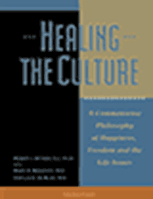
As a Franciscan, we are the people of Franciscan joy, this interested me. The article focused on the four levels of happiness presented in “Healing the Culture” by Fr. Robert J. Spitzer, a Jesuit. Now I won’t hold that against him, though one would think this topic belonged to a Franciscan.
The four levels are:
  1. Bodily Pleasure. Food, drugs, sex. (L1)
  2. Competitive Advantage. (L2)
  3. Loving and Serving Other People. (L3)
  4. Loving and Serving God. (L4)

Before I expand on the four levels I’ll turn to an article in Psychology Today. It says, “Positive psychology is the scientific study of what makes life most worth living. It is a call for psychological science and practice to be as concerned with strength as with weakness; as interested in building the best things in life as in repairing the worst; and as concerned with making the lives of normal people fulfilling as with healing pathology.” In my twenties I subscribed to this magazine as I was interested in how I and others tick. I think this branch of psychology has taken a great leap. The article goes on to list the following as to what has been learned recently:
• Most people are happy.
• Happiness is a cause of good things in life and not simply along for the happy ride. People who are satisfied with life eventually have even more reason to be satisfied, because happiness leads to desirable outcomes at school and work, to fulfilling social relationships, and even to good health and long life.
• Most people are resilient.
• Happiness, strengths of character, and good social relationships are buffers against the damaging effects of disappointments and setbacks.
• Crisis reveals character.
• Other people matter mightily if we want to understand what makes like most worth living.
• Religion matters. [My emphasis. It took them a long time to realize this.]
• And work matters as well if it engages the worker and provides meaning and purpose.
• Money makes an ever-diminishing contribution to well-being, but money can buy happiness if it is spent on other people.
• As a route to a satisfying life, eudaimonia trumps hedonism. [I had to look this one up, eudaimonia: a contented state of being happy and healthy and prosperous.]
• The "heart" matters more than the "head." Schools explicitly teach critical thinking; they should also teach unconditional caring.
• Good days have common features: feeling autonomous, competent, and connected to others.
• The good life can be taught.
So L1 is concerned with bodily pleasures. This of a baby. He/she is all about bodily pleasure: contentment, warmth, touch, food, diaper change. The problem with L1 is that it brings happiness that doesn't last long. If you are hungry and eat you receive happiness until your full. You also build up a tolerance this is where addiction comes to play or obsession/compulsion. This brings on pain, not happiness, to oneself and others.  Becoming obese, or an alcoholic, or as they say a sex maniac.
L2, Competitive Advantage is basically about money, keeping up with the Jones’ or rather surpassing them. But it manifests in other ways as well, power, popularity, status,  and fame. Here we see happiness though victory. “I beat out Ed for that promotion;” “I’m prettier than her.” It could be winning an award, being chosen to a good school, first in class, elected class president, prom king/queen, getting a date with that hottie, etc. We know the adage “He who dies with the most toys wins.”
Most of these things are good in themselves and we should try to exceed, encourage our children and others. But does in bring lasting happiness? Many people think that having and spending money brings happiness. But when studied this is not necessarily true. Once you have your basic needs met, more doesn't necessarily bring happiness. Shelter: we might live in an apartment or live in a million dollar home, yet we both have shelter. Clothing: We have that winter coat, some have a mink, we’re both warm. Great wealth doesn't mean great happiness; just look at St. Francis.
The OSV article points out, “Soon after having achieved a particular level of wealth or having purchased the desired product, the happiness recently enjoyed will fade and disappear.”
“Think about your last birthday. Do you still have the thrill of opening your gifts?” You probable hardly recall what you received.
Now the flip side of all this wealth, fame, power gained it it’s effect. Think of how many celebrities go down the drain: Michael Jackson. He had it all, did he not? So many others dying from drug addiction. .. Others, power going to their head, divorce, legal actions, rehab. “Happiness cannot be found in bodily pleasures, money, fame, popularity or power. Level one and level two cannot deliver happiness.”
Before I go on to L3 and L4, I wanted to mention that I also ran across a YouTube video by Martin Seligman: The new era of positive psychology. It is 23 minutes long but interesting.  See my next post. Martin has a number of books. I just bought “Authentic Happiness: Using the New Positive Psychology to Realize Your Potential for Lasting Fulfillment”
The article points out that psychologists find the happiest people have”
  1. Meaningful activity
  2. Good relationships with others
  3. Strong religious ties
So it seems the key to happiness is in loving ourselves, others and God. Well, we knew that, didn't we? So we need not neglect L1 and L2. We just need to put them in their proper place. This brings to my mind our great Catholic tradition of fasting, humility, almsgiving, Confession, Adoration, etc. So we have the key to true happiness. We just need to work on it a little. Self-indulgence is a nice treat but should not be our focus.
To finish up, I ran across a neat exercise that I started to do myself. Each night think of three things that made you happy that day. Best to journalize. This will remind us of God’s constant gifts. My first one last night was:  1. My boss was not at work today. Now that is happiness!
O.K. I’m off to McDonald’s.


Thursday, December 20, 2012

Take the Christmas Pledge!


Take the Christmas Pledge!


My Christmas Pledge with Prayer to the Infant Jesus

I Promise . . .
1. To make my Christmas a holy day with Christ-----not a holiday without Him.
2. To observe Christmas as the birthday of Christ-----not  to give and receive material gifts. 
3. To remember that the real symbols of Christmas are the Star, the Stable and the Crib-----not Santa Claus and his reindeer.
4. To teach my children that "Santa Claus" is the nickname of St. Nicholas-----who gave to the poor in honor of Christ.
5. To help one poor family-----in honor of Jesus, Mary and Joseph, the Holy Family of Bethlehem.
6. To send Christmas cards mindful of Him, the Infant Savior-----not decorated only with candy canes, dogs, ribbons, and wreaths.
7. To make room in my home for Him-----with a Christmas Crib to remind me that He was born in a stable.
8. During the Christmas season, in a special way, to honor Mary, His mother-----who kept the first Christmas vigil beside the manger.
9. To begin Christmas by leading my family to His altar-----to receive the Bread of Life.
10. Today and every day, to give "Glory to God in the highest"-----to work and pray for "Peace on earth, to men of good will."

Nihil Obstat: Joseph A. M. Quigley, Censor Librorum
Imprimatur, + John J Krol, D.D., J.C.D., Archbishop of Philadelphia, March, 1964

Prayer to the Infant Jesus
Come to me, O Divine Savior, vouchsafe to be born in my heart. Grant that, taught by Thine example, and assisted by Thy grace, I may be poor in spirit and humble of heart. Keep me chaste and obedient. I wish to live but for Thee, and to do all things purely for love of Thee.

O Mary, my Advocate and Mother, obtain by thy prayers forgiveness of my past offenses and holy perseverance unto death. St. Joseph, do thou also pray for me, that I may become daily more pleasing to Jesus. Amen.
WITH ECCLESIASTICAL APPROBATION


Merry Christmas to all, especially to those who have touched my life in this last year.