Sunday, September 28, 2008

Dolores Hart

From Tom S.F.O.

Catholic Exchange has an interesting article/interview on/with Dolores Hart. It starts:


Once an in-demand Hollywood actress, Dolores Hart shocked the entertainment industry when she gave up everything to become a cloistered Benedictine Roman Catholic nun. She left her career, broke off her engagement to Los Angeles businessman Don Robinson, and pursued her vocation as a nun.


Find the rest here.


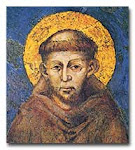
A Franciscan connection is that she played Clare in the 1961 movie Francis of Assisi.


Friday, September 26, 2008

Confession is like going to the Dentist

Standing on My Head by Fr. Dwight Longenecker has a good short article on Confession. It starts:

When people come to confession they often have something on their conscience which makes them feel guilty, ashamed or scared.

Most often this is something where they've lost control. Maybe it is a sin that is 'below the belt', something to do with food, drink or drugs, losing one's temper, being violent etc. This sin of passion makes them feel guilty or ashamed or scared, but despite their strong feelings it may not be the most serious sin, or the thing which is keeping them from God.

Read the rest here.

Compline - Liturgy of the Hours


I'm a fan of the Anchoress. She has recorded Compline - Night Prayer, for every day of the week. Her recordings are beautiful and meaningful. She has a great voice. You can find her Podcasts here.


Compline is prayed/recited just prior to bed. Don't forget to do a short examination of conscience before hand.

40 Days for Life

This is the time to stand up and join this effort.

Saturday, September 20, 2008

S.F.O. Life and Apostolic Activity

Browsing the Internet I ran across this article and thought I would share it in its entirely.

LIFE AND APOSTOLIC ACTIVITY
Emerenziana Rossato SFO
Franciscanism qualifies as a way of life,that is as an evangelic and fraternal experience.Starting from the SFO rule and the Constitutions we shall examine two highly existential moments:life and apostolate.

The second chapter of the new Constitutions deals with the "-Form of life and apostolic activity-". Both the Rule and the Constitutions underline the value and importance of the form of life associated with the apostolate for the Secular Franciscan. This is so because at the moment a secular franciscan takes the Rule seriously enough to conform her or his life to it, apostolic activity will become an important and logical consequence.

To give the Rule this power is linked to the certainty that at the bottom of it all there is a vocation, which is the key to everything. We have entered the SFO because of a vocation which is fundamental because it is a part of God's salvific plan for us, for whose fulfillment we should be ready to give our lives.

The initiative was His, not ours. It is God who calls and continues to call and at each call chooses, destines, places and guides a person. God calls for a certain purpose and furnishes the means to reach it. He calls for the benefit of the person but also for the benefit of the community. And it is the answer of the person that fulfills or not fulfills the will of Him who calls. So each fulfillment of a vocation will never be a small matter, but a fullness of grace.

Each vocation echoes and vibrates in the person concerned with particular accents of gifts, illuminations, talents, and sensibilities, different internal and external situations. We are called to deepen the components, the characteristics and the dimensions of our vocation in order to answer it well and not to eliminate it.

We gave our first affirmative reply with our Profession, the public ecclesiastical act that brought us into the Fraternity. We professed in the Church, creating a new bond. We professed the Rule, that is a way of life, and entered the Franciscan family. This personal reply asks for continual fidelity if we want to realize our vocation. We should often remember our given word, our solemn pledge and try to keep our promises.

Living our Profession is part of a personal dedication that precedes that of the community, just as the apostolic action of the Fraternity presupposes that of the single person linked to the conversion of our heart. Because it is not the SFO, but the single member which can be transformed. It is not the SFO as such that makes us what we are, but our own personal virtues. This is so even if it goes without saying that the strength of the Fraternity can stimulate new desires, renew our lives and give us franciscan happiness. It is the personal virtues of each one put together with those of the brothers and sisters that gives light, splendour and life to the Fraternity.

Living our vocation and our Profession presupposes the Rule, a great gift that tells us who we are, how we should live and what we must do.

The first Chapter describes our nature and our identity; the second, the form of life to acquire; the third, life in Fraternity. All three Chapters are essential. By realizing the third chapter, we can more easily live the second and reach the goals described in the first.

God's design for us is fulfilled through the Rule that shows the direction and the form our vocation should take to qualify as secular Franciscans. The Rule gives us a "-Form of Life-" in relationship to God, to human beings and to the whole creation.

It is good to note that the new Constitutions have no other purpose than to help us to understand the Rule, explaining its parts and indicating concrete solutions.

From the Rule's 26 Articles, sixteen regard the "-Form of Life-". It is this form of life we should realize, observing the Gospel of our Lord Jesus Christ according to the example of St. Francis of Assisi.

Therefore, passing from the Gospel to life and from life to the Gospel; looking for Christ in our brothers and sisters; being witnesses and instruments of the mission of the Church among people; conforming our way of thinking and acting to that of Christ; making prayer and contemplation the soul of our being and working; proclaiming love for the Virgin Mary and following her example; faithfully fulfilling our obligations in our state of life.

Therefore, the right use of possessions; purity of heart; fidelity to our vocation; the acceptance of our brothers; competently carrying out our responsibilities; initiatives in favour of justice; the spirit of peace; respect towards all creatures; faith in the presence of the divine seed in people and the transformative power of love and pardon; serenity in awaiting the final encounter with the Father.

The Constitutions reinforce and explain the Rule. They speak of the "-Form of Life-" in the first part of the Second Chapter, composed of 9 Articles: from 8 to 16.

The Constitutions stress the commitment made by our profession to live the Gospel according to Franciscan spirituality in our secular condition, according to the Rule of the SFO in a journey of conversion; open to the opportunities that come from society and from the Church; in the personal and communal dimensions of this journey (Const. 8).

Franciscan spirituality is called a plan of life centered on the person and on the following of Christ, rather than a detailed program to put into practice. It asks for study and love of the Gospel, to know and understand it as it is proclaimed by the Church (Const.9).

Christ, "-poor and crucified-", the greatest manifestation of the love of God for humanity, is for Secular Franciscans the book wherein we learn the way of living, loving and suffering; in which one discovers the value of contradictions, the meaning of the difficulties and the crosses, the Franciscan spirit of peace (Const. 10).

Mindful that the Holy Spirit is the source of their vocation, Secular Franciscans should desire above all things "-the Spirit of God at work within them-" (Const.11).

We are called by the Constitutions to live with faith the great gift Christ has given the revelation of the Father and to bear witness of it before all: in family life; in work; in joys and sufferings; in associating with all, brothers and sisters of the same Father; in our presence and participation in the life of society; in fraternal relationships with all creatures (Const. 12).
We need a spirit of continual conversion, both individually and in Fraternity that brings with it love for the renewal of the Church; love for the works of charity in the interactions with the brothers and sisters; love for penitential practices (Const. 13).

We are called to a faith-inspired reflection on the Church as the universal sacrament of salvation; on its mission in today's world; on the role of the Franciscan laity within the Church to foster its growth and the spreading of the Kingdom.

We are called to make the Eucharist the center of our lives and of the Fraternity; to give priority to the celebration of the Liturgy of the Hours; to find times of silence and recollection dedicated exclusively to prayer (Const. 14).

The constitutions urge us to live the spirit of the Beatitudes and, in a special way, the spirit of poverty that demonstrates confidence in the Father, reduces personal needs in favour of those most in need, effects interior freedom and promotes a more just distribution of wealth, attentive to the instructions of the Church and the demands of society (Const. 15).

We are urged to look at Mary as a model of listening to the Word and of faithfulness to one's vocation: we, like Francis, see all the gospel virtues realized in her. To Her then our intense love, imitation, prayer and filial abandonment (Const. 16).

Mary has given the Word flesh and bones, and went to Elizabeth. And as everyone in life has an "-Isaac-" to immolate, a "-leper-" to kiss, a "-wolf-" to tame, everyone has an "-Elizabeth-" to visit. "-Pray to Mary and run-", goes a Spanish saying. A good listener...

Franciscan Charism

Patrick Colbourne OFM Cap. has a good article on SFO Franciscan Charism. It can be found here.

It starts:

When I speak of charism in this paper, I intend to signify a gift of the Holy
Spirit that promotes a response to the Gospel that involves a specific Gospel
insight which is put into practice in a specific environment. We may refer to a
person's response to the Divine as their spirituality. Within this general area,
people are gifted with particular insights, particular vocations, to live within
specific circumstances as they respond to God's presence in their lives.
Although he admired saintly monks, St Francis was not a monk. Although he
supported, challenged and encouraged lay people, he was not a Secular
Franciscan. There is something very specific in every call from God to holiness,
and it is that specific quality we seek to explore as it is described in the
Pauline Rule of the SFO.
When promulgating the SFO Constitutions, Emanuela
De Nunzio mentioned three specific characteristics of the SFO: secularity, unity
and autonomy. These qualities are all set out in the first two paragraphs of the
Pauline Rule. The SFO is secular in so far as its members "strive for perfect
charity in their own secular state" (Rule 2). The Secular Franciscan Order is
one is so far as "it is an organic union of all Catholic fraternities scattered
throughout the world" (Rule 2). It is autonomous in so far as it carries out its
vocation within the Franciscan family, under the common fatherhood of St.
Francis, "in various ways and forms but in life-giving union" with the other
branches of that family (Rule 1).

A highlighted extract follows:

Because Seculars live in the context of "the world", they are in a privileged
position to demonstrate that there is no disjunction between life in the world
and living the Gospel. The Gospel is not an artificial adjunct to human life,
and one does not have to withdraw from human life to live the Gospel.
The
Rule exhorts them "to go forth as witnesses and instruments of her (the
Church's; italics mine) mission among all people, proclaiming Christ by their
life and words" (Rule 6). The Rule suggests that union with Jesus for the
Secular Franciscans consists in their "faithfully fulfilling the duties proper
to their various circumstances of life" (Rule 10).They must necessarily come
into contact with the goods of the world, but they are exhorted in the Rule to
simplify their material needs and to remember that they use material goods as
stewards (Rule 11). In the spirit of the beatitudes, as pilgrims and strangers
on their way home to the Father, they should mortify and tendency to possessions
or power (Rule 11). In their families they are urged to promote peace, fidelity
and respect for life and as husbands and wives they should bear witness to the
world of the love of Christ for his Church (Rule 17).

I would urge a reading of this entire paper.

Friday, September 19, 2008

The Truths We Hold...

Richard Neuhaus has an interesting article in First Things. It begins:

"At least since Ronald Reagan vs. Jimmy Carter in 1980, the question of religion in public life and, more specifically, the meaning of “the separation of church and state,” has surfaced in presidential elections. Sen. Obama has been working hard to overcome the perception that his party is not only secular but anti-religious. At the same time, Sen. Obama’s supporters have been raising alarms[sic] about the unabashed religious commitment of Gov. Palin."

Find the rest here.

Response to Charles Gibson's Holy War Question

The Anchoress has a great video in response to Charles Gibson's question to Sarah Palin "Are we fighting a holy war?" Find it here.

The SFO Rule No. 17


"In their family they should cultivate the Franciscan spirit of peace, fidelity, and respect for life, striving to make of it a sign of a world already renewed in Christ. By living the grace of matrimony, husbands and wives in particular should bear witness in the world to the love of Christ for His Church. They should joyfully accompany their children on their human and spiritual journey by providing a simple and open Christian education and being attentive to the vocation of each child."


Though the name of this blog is Tom S.F.O. I note that most of my posts are not of a Secular Franciscan nature. I hope to correct this in the future.
I have read the Rule many times over the years. I did so again today. Perhaps Number 17 of the Rule, quoted above, never hit me before. As a bachelor perhaps I glossed over it with its mention of family and marriage. But what struck me today was the words "respect for life". Perhaps in previous readings I understood this to reference all of nature, all life. But today I hear it telling me respect for the unborn human life.
From a sampling of my previous posts my prolife conviction is readily known. But for this to jump out to me today is interesting. That respect for life is in my Rule. It is like it has not dawned on me before.
As Franciscans we are called to follow the Pope and the Magisterium of the Church. When it comes to respect for life I don't need the Pope or the Church to tell me that the killing of the unborn is wrong and a grave sin. It is within us. In our very nature. It is unfathomable to me to think that for some this is not so.
We all know of the cafeteria Catholics who pick and choose what they will. When it comes to abortion I am unable to understand that this is O.K. I am so happy that many Bishops have spoken out and corrected those pro-abortion "Catholics" who receive the Eucharist.
What has troubled me in the recent past was that there was a Secular Franciscan in my Secular Franciscan Region who ran for congress who was very vocally pro-abortion, running against a pro-life incumbant. She lost. But what grieves me is that no one from her Fraternity, not the Region, nor National made any attempt to correct her. Without contrition and a change of heart she should have been booted from the order.
Though we are not to judge, there are times we are called to correct our brother or sister who is in error with love and compassion. But to completely ignore the issue is wrong in my judgement. As a parent corrects a child who is in error out of love. So must we as Catholics correct each other, especially in a matter so grave.


Wednesday, September 17, 2008

Acedia

Acedia has appeared in the blogosphere of late, Deacon Greg for one, generated by Kathleen Norris' book "Acedia & Me". Not familiar with the term? Neither was I, but we are familiar with acedia, if not by name.

The American Heritage Dictionary defined acedia as: "Spiritual torpor and apathy; ennui." Not much help? Torpor: A state of mental or physical inactivity or insensibility. Ennui: "Listlessness and dissatisfaction resulting from lack of interest; boredom".

I have not read Kathleen's book (yet). But here is my take. Mostly, we live in our own world. Morning routine, travel, work, travel, dinner, television, sleep. On the weekends it is housecleaning, shopping, errands, yard work, perhaps eating out, some entertainment, hopefully church. We all have our own routine. Other then watching the news (usually biased - let them think for us) we know little (or care) what is happening around us. It usually takes something to jog us from our torpor.

There are so many things out there that needs our attention. We can't do everything, but we can do something. My blog quote is from Edmund Burke "All that is necessary for the triumph of evil is that good men do nothing."

My answer to acedia is to pray and act. Find some form of prayer a few minutes a day, for me it is the Liturgy of the Hours. Find something that touches your heart, something that needs you. You know your talents. There are so many ways to contribute. And you will find it most rewarding.

Like I said it usually takes something that jogs us. In 1991 when my mother died the Church extended itself toward me. I decided to repay the kindness by becoming an active member of my parish, I was no longer satisfied with being a Sunday morning Catholic. I soon became a Lay Minister and it was also at this time I found my calling to be a Secular Franciscan.

But what touched my heart was abortion. I wrote about it when I started this blog. You can find it here. But I didn't know much about it. I didn't have the facts. So I began to read about it. The more I did, the more my conviction grew. I soon started a Respect Life Committee in my parish.

Here is where acedia hit me. When I started the committee, put information about an inaugural meeting and information night, only a few showed up. This was in a parish that had over 3,000 families registered. Where was everyone? Didn't they care? Acedia.

But you know - I didn't realize it then - these few people were all we needed. We were a thriving group and did many things, held baby showers, raised funds by selling roses on Mother's Day, conducted pro-life prayer services, letter campaigns, etc.

So don't let acedia take hold. Pray. Find something, alone or start a group. Write your legislators. Vote.